• Bible Films Blog

    Looking at film interpretations of the stories in the Bible - past, present and future, as well as preparation for a future work on Straub/Huillet's Moses und Aron and a few bits and pieces on biblical studies.


    Name:
    Matt Page

    Location:
    U.K.


    Thursday, March 19, 2026

    La Passione (Carlo Mazzacurati,2010)

    Silvio Orlando as the director leans over the shoulder of the actor playing Jesus in a scene from the play in the film
    I just came across this interesting sounding Italian "making a Passion play" film, La Passione directed by Carlo Mazzacurati in 2010. The plot seems to be that a film director reluctantly agrees to direct a small Tuscan town's Good Friday celebrations in order to avoid getting sued. So it's another film about people making a Passion play.

    I came across it looking at the filmography of one of Nanni Moretti's frequent collaborators Silvio Orlando, who has starred in at least 4 of the films directed by Moretti as well as co-starring in Mia Madre (2014). 

    From the look of the trailer its a comedy, perhaps albeit with some more emotional moving reflection at the end of the film. There also seems to be some borrowing from Jesus of Montreal (1989). This clip certainly has some familiar resonances, so I'm assuming an influence on some level, if not actual homage.

    I'll try and get hold of a copy and see what it's like and report back. Meanwhile I've updated my list of Italian Jesus films to include this and a number of other titles I've discovered since 2019 when I first wrote it.

    Labels: ,

    Sunday, March 26, 2023

    La ricotta (1963), revisited

    Sixteen years ago now I reviewed Pier Paolo Pasolini's 30-minute short La ricotta (1963), which was released as part of the anthology/portmateau film RoGoPaG. I've changed a lot since then, not least becuase now I've seen all of Pasolini's films – some of them multiple times – and read a lot and spoken about his movies as well. So I thought it was time to revisit this one, as I sat down to watch it in its entirety for the first time in a while.

    Multiple crucifixions
    The first thing that struck me was the multiple crucifixions we find here, all stacked up against one another. Most obviously we have the gaudy technicolor reconstruction of the film within a film – a close reproduction of Rosso Fiorentino's Mannerist "Deposizione dalla croce" [aka "Deposition of Volterra"] (1521) – but this is not the only depiction of the crucifixion in the film with the film, because the scene in which Stracci features stars a Jesus who looks significantly different (there's no long red hair for one thing). In another sense though, Stracci's death is also a crucifixion of sorts. He dies on the cross, perhaps even, one could argue, for the sins of the world, and the final line of dialogue from Welles's director, recalls the centurion at the foot of the cross. Stracci's own final lines are significant too.

    But there is another scene that functions as a crucifixion scene, that is not so widely talked about. as the crew set up one of the shoots for the crucifixion scene we witness Stracci and the actor playing Jesus. While they are lying, nailed to their crosses, on the ground, the camera looks "up" at them as if the shot is taken at from the foot of the cross. Like the rest of the cast and crew the Jesus-actor talks down to Stracci, and their dialogue could be easily construed as just that. However, on closer inspection there's more to it:

    Stracci:
    I'm hungry. I'm hungry.
    Now I'm going to blaspheme.

    "Jesus":

    Just try it and see what i give you.

    Straci:
    A fine Christ you are. You think
    I've got no right to grumble?

    Jesus:

    Suit yourself, but I won't take you
    into the Kingdom of Heaven.

    Stracci:

    I could be okay in the
    Kingdom of the Earth.

    (The argument moves on to politics)

    This dialogue works as an ironic take on the text from Luke's Gospel. Instead of the thief humbling himself to beg a receptive and willing Jesus for entry into the Kingdom of Heaven, we have an already humbled Stracci talking up his suitability for the kingdom. Meanwhile the Jesus actor is anything but the figure we find in Luke 23. Rather than be gracious and receptive he acts like a petty and mean-spirited gatekeeper.

    Sweary Mary
    Sixteen years I didn't know any Italian, but I started learning around 2013-4 and have been making slow progress since. Enough, at least, to spot the odd thing that you don't get from the subtitles. Here, for example, there's a scene where the actors are trying to capture the deposition from the cross, reproducing the exact poses of another Mannerist, Jacopo da Pontormo's "Deposizione" (1528). Pasolini has studied the history of art, and knew his Mannerism, so he would have know that "its adherents generally favored compositional tension and instability rather than the balance and clarity of earlier Renaissance painting".(1) So Pasolini makes a visual art-joke, demonstrating the "instability" of the composition by having the actors – who have been ordered to hold their poses still, rather than move and act – collapse after a while. This is rather unsurprising given the general messing around that has been occurring on set and taken to be typical of the attitudes that Pasolini seeks to highlight. Most of the actors laugh and see the funny side.

    One person, however, is not impressed. The film's major star, "Sonia, la 'Diva'" played by Laura Betti, is playing Mary, Jesus' mother. While her co-stars laugh-off the whole incident, she is incandescent with rage. Her voice though is not added to cacophony of sounds emanating from the cast at this point, which almost seems to add to her frustration. However, it's clear that one of the words she shouts several times is "basta", the Italian for "Enough!" only here it's probably a bit stronger in Italian than that literal translation. I can't lip read the rest, but I'd love to hear from anyone who can. I do wonder if this was the moment that was the tipping point for those who decided to press for Pasolini's prosecution (that said, Geoffrey Nowell-Smith says, in this piece, "that the real target of the prosecution was not La ricotta at all but the much talked about Gospel". In other words that this prosecution was a shot across Pasolini's bows.

    Accattone and Stracci
    This time around I was struck by the similarities between the title character (I won't say "hero") of Pasolini's debut feature Accattone (1961) and Stracci, the lead character here. Both characters have meaningful names. Accattone means "Beggar" or more colloquially ‘deadbeat’ or ‘grifter’. Stracci means "rags". The meanings of both resonate through their roles. While both are the lead characters, neither of them is a hero – not in any conventional sense at least – or even, really, an anti-hero.

    More importantly for Pasolini was that they were both representatives of the bottom layer of Italian society that he treasured so greatly. For Pasolini it was this strata of society that most opposed neo-capitalism and refused to play by its rules, and was also where the last remaining vestiges of the sacred could be found.

    Pasolini was hugely critical of bourgeois society, and the more I look into his work the more I am convinced he would have hated me and the majority of those who so value his films today. And this is perhaps why I find both Accattone and Stracci so difficult to sympathise with, certainly to understand their actions. Stracci is the more sympathetic. Selling a dog to buy food when you're starving is more understandable than grooming and then pimping out a young girl, but the way Stracci eats to such excess proudly refuses to make him a conventional tragic-hero and imbues the whole film with the sort of comic approach that Pasolini was going for.

    The actor playing Stracci, Mario Cipriani had appeared, uncredited in Accattone and Mamma Roma (1962) and would do so twice more, firstly in "La terra vista dalla luna" his contribution to another composite film Le streghe (The Witches, 1967), then in "Che cosa sono le nuvole?" in another joint film Caprice Italian Style (1968). Franco Citti, who played Accattone, would go on to become one of Pasolini's biggest collaborators, fronting a number of his movies throughout Pasolini's 14-year career.

    The cruelty
    Not unrelated to the above is the cast and crew's treatment of Stracci. This time around I was struck by how unrelentingly cruel it is and how it seems to be generated largely by class hatred. Stracci is never shown as being part of the group or having any form of social acceptance. Sonia's dog is welcome on site, and even catered for, but Stracci's family have to remain at a distance. Even when his costars appear, they smile wave and pass by like the opening characters from the Parable of the Good Samaritan. The scene where Stracci overeats to bursting point is particularly noticeable – everyone goads and bullies him into eating more and more, pitting the desperation of his hunger against his human dignity – but this behaviour occurs elsewhere. Once when Stracci is fixed to the cross, and mentions his hunger, a co-star offers him bites from his sandwich to taunt him before another man pours drink down his throat and he is mocked in every scene.

    I suspect this behaviour is not so much a call to the middle classes to improve their behaviour to other classes as it is to say to the sub-altern/proletarians that "this is how they will treat you if unrestrained"


    While it tends to be Il vangelo secondo Matteo, Teorema (Theorem, 1968) or Salò o le centoventi giornate di Sodoma (Salò or the 120 days of Sodom, 1975) that are Pasolini's most celebrated films, there's a very strong case for La ricotta being his best short film, and his greatest comedy. And while there were often strong objections to his work, and threats of prosecution, I believe it was the only time Pasolini was convicted for one of his films.

    Given its release came at a similar time to the start of the Vatican II Council I can't help but wonder if the timing was deliberately provocative, even for such a mild film by today's standards. Pasolini considered himself an atheist, but one who nevertheless realised the important and varying role the church played in Italian society in general. So while Il vangelo remains the more insightful film about the Gospels, La ricotta speaks with more insight and passion about the role of the Roman Catholic church at just the same time that the institution itself was undergoing major self-examination; and about Italian society in general and its often hypocritical attitudes to religion.

    =========
    1- Finocchio, Ross (2003) "Mannerism: Bronzino (1503–1572) and his Contemporaries", Department of European Paintings The Metropolitan Museum of Art website. Available online -  https://www.metmuseum.org/toah/hd/zino/hd_zino.htm

    Labels: , , , ,

    Sunday, September 30, 2018

    La vie et la passion de Jésus-Christ (1898)


    The first biblical films date all the way back to 1897. Albert "Léar" Kirchner's La Passion du Christ and The Horitz Passion Play by Mark Klaw and Abraham Erlanger, are now, sadly, considered lost, as is Siegmund Lubin's The Passion Play from the following year.1 In a similar manner almost all of the 1898 silent The Passion Play of Oberammergau, which was famously shot on a New York rooftop rather than in Bavaria, has been lost, though a fragment has survived.2

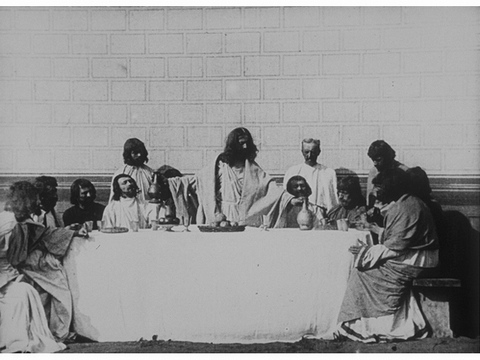
    The earliest remaining Bible film, then, is La vie et la passion de Jésus-Christ (The Life and Passion of Jesus Christ, available online here) by George Hatot and Louis Lumière. Shot in France 1898 when most moving pictures were little more than short slices of real life (les actualités) it retains something of that documentary feel - is this a film about Jesus or the filming of a real-life play about Jesus? Any audience is kept off screen, but the sets retain the feel of an amateur stage production. Furthermore, the placing of the camera in several scenes feels as if it is placed at the side of an audience. These aspects are perhaps most obvious in the crucifixion scene where the shadow of the cross falls not across the ground, but against the back wall. Strangely the scene that feels most like it has been made with the camera in mind - the Garden of Gethsemane - is the one shot outdoors in the most natural setting. At the time documentary footage was commonly shot outside. Drama tended to be set indoors.

    Louis Lumière, of course, was the man who, along with his brother Auguste, "invented" cinema, by being the first to display moving pictures to a paying audience. The company the two founded for a while specialised in these actualités but also made comedies and the occasional reconstruction of historical events. Hatot was one of their key early collaborators, first on early documentary footage, but around this time also began to specialise in reconstructions of famous deaths including Mort de Robespierre (1897) and the execution of another religious martyr in Exécution de Jeanne d'Arc (1897).3

    Whilst the title of this film is The Life and Passion of Jesus Christ, very little of Jesus' ministry is actually shown. The film starts with the Magi and the Shepherds worshipping Jesus as a baby in a manger, and is followed by a flight to Egypt scene where Mary, Joseph and Jesus stop to rest between the paws of a/the Sphinx. It's a scene that would be reproduced almost fifteen years later in From the Manger to the Cross, only that time shot on location in Egypt.

    All that lies between that and Jesus' Passion is a solitary miracle - the raising of the Widow of Nain's son. This scene is rare in Jesus movies, providing neither the human interest of the raising of Jairus' daughter, nor the prophetic resonance of Lazarus breaking out of his tomb. Here though is is handled in a relatively low key manner. The adult son is brought out to Jesus on a stretcher. Jesus (Gaston Bretteau) simply raises his arm and the man sits up, his sheet falling away as he does so.

    The lack of spectacle at this point is made all the more interesting by the inclusion of an invented miracle slightly later on. The Last Super scene, shot statically, from slightly close up, starts focused on Jesus' empty chair whilst various preparations are made. Suddenly there's a cut and Jesus appears in their midst. The disciples react with astonishment.

    Such jump-cut reappearances were relatively common at the time. Georges Méliès was in his prime and produced numerous short films making use of the technique that same year. These included the religious picture  La tentation de Saint-Antoine (The Temptation of St. Anthony) which featured the titular saint desperately trying to keep his mind on his prayers whilst young women keep materialising to tempt him, including including a moment when a statue of Jesus comes to life. Not only did this make him a forerunner of all those directors who entertained their audiences with a potent mixture of sex and religion, but when the following year he used his camera tricks to portray one of Jesus' miracles in Le Christ marchant sur les flots (Christ Walking on the Water, 1899), he became the first filmmaker to create both a reverent film about Jesus and an irreverent comic depiction of the crucifixion.

    More to the point, Georges Hatot himself, having started his career making actualité films of every life such as street scenes and military parades, began elaborating on the jump-cut technique. Whereas it is absent from his 1897 film Mort de Marat, and only used once in Métamorphose de Faust (1897). Having made La vie et la passion the following year, he then moved to Gaumont with Bretteau (who had played Jesus) to remake the Faust story. The resulting Les métamorphoses de Satan (1898), which Bretteau both starred in and co-directed made repeated use of the tec"hnique to portray as Mephistoles, Satan and a young woman continuously appear and disappear.

    It's more than possible, of course, that the jump-cut scene in La vie et la passion was at one stage intended as the episode in Luke where the resurrected Jesus miraculously appears amongst the disciples, but the resulting scene here is quite clearly The Last Supper: not only are their echoes of Leonardo's painting, but Jesus distributes the bread and wine and Judas kisses him on the cheek.

    The success of this film did little to dissuade other filmmakers from producing their own versions of Jesus' life and death. In particular, Pathé brought out their own tableaux-style Jesus film called La vie et la Passion de Christ in 1899 which gradually expanded (in both number of scenes and title length) through three new versions around up to 1913. There are a few posts on these films (now including this one) on this thread. The relationship between them itself is fairly complex. Hopefully I will be able to expand on it some point, but if you can't wait until then I encourage you to look up Boillat and Robert's article as detailed below.

    ===================
    1 - Boillat, Alain and Robert, Valentine. (2016) "La Vie et Passion de Notre Seigneur Jésus-Christ (1902–05)" in The Silents of Jesus in the Cinema (1897-1927); ed. Shepherd, David. p. 27

    2 - According to Kinnard and Davis, a 35mm fragment of the film remains in the George Eastman House archives. The film was produced by Rich G. Hollaman despite the fact he had never actually seen a movie before. He proved so inept at the task that the rest of the cast and crew teamed up to shoot it in the early evening once he had left for the day. These days Henry C. Vincent is credited with being the director, but this marked the first time the roles of producer and director had been separated (The Guinness Book of Film Facts and Feats).

    3 - Abel, Richard (1994) The Cine Goes to Town: French Cinema 1896-1914, Berkeley: University of California Press. p.91 The observation about famous deaths is thanks to Luke McKernan.

    Labels: , , , ,

    Sunday, April 01, 2018

    Jesus Christ, Superstar (1973) Revisited


    I thought as it was Easter Sunday (at least in the Western Churches) that I should post about a Jesus film and as earlier in the day my family sat down to watch Jesus Christ, Superstar (1973) I thought this would be a good place to start since it's been a long time since I wrote anything about that film at all.

    One of the thing that I've mentioned before but never on the blog is that what is unique about the piece is that the film's numerous solos give us an account of things from the perspective of each of the major characters in turn. The solos let us inside their heads, including Judas (various starting with "Heaven on their Minds"), Mary ("I Don't Know How to Love Him"), Jesus ("Gethsemane"), Pilate ("Pilate's Dream"). Herod ("King Herod's Song"), the Priests ("Then We Are Decided") and even Simon the Zeaot ("Simon Zealotes"). These songs function as internal monologue, something that is typically absent from biblical films. Even when it is present, such as in Last Temptation of Christ (1988) it is only from one character's perspective, rather than seven or eight.

    But enough of previous observations, what about this viewing? One thing that really stood out to me this time was the extent to which the film seeks to be more inclusive. Whilst Jesus and a number of the other lead part are played by white men (Herod, Caiaphas and Pilate), Judas is African Carribean, Simon the Zealot is mixed race and Mary Magdalene is Asian American. This diversity is all the more apparent when looking at the broader range of actors including the chorus. The number of non-white face is far more extensive and women are prominent amongst Jesus' followers, as well as in other roles ((although not his disciples, nor amongst the priests). There are even a few shots of two men with their arms around one-another, suggesting the film is also positive about same-sex couples.

    In this respect the film goes far further than the play. In Lloyd-Webber and Rice's original rock opera Mary is the only principle female part. Indeed even though the dream that Pilate's wife has in Matt 27:19 is covered and indeed developed into a song in its own right, it is transferred to being the dream of her husband, the two characters are conflated into one, and Claudia is left out of the script. Here though, just as Pilate's song comes to an end a woman comes to him and the two act if they are equals, and seemingly, then, husband and wife. Later, the same woman appears in two shots accompanied by two other women, but both times the shot cuts to Pilate next and there is something disapproving in the way they are looking at him. It's a small nod towards recognising the character's role, but there nevertheless.

    One of the things that is famous about the film is the way it blends modern and ancient imagery: whilst the Jesus story is "set" in first century Judea, the film takes place in modern Israel; costumes are deliberately anachronistic; the presence of tanks, aeroplanes, and many of the items on display in the clearing of the temple scene are from the twentieth century not the first; and the language does not even attempt authenticity. Another aspect of this is the al fresco Last Supper scene which actually introduces a third era into the mix by copying the composition of Leonardo's famous fresco, both in wide shot and in this close up shot where the position of the disciples hands matches (more or less) the pose from Leonardo's famous mural.

    One thing I particularly appreciated this time around is the complexity of some of the shots, including a long shot of Caiaphas and Annas during "Then We Are Decided" and the one through the hole in the cave at the start of "What's the Buzz?". One that is particularly impressive is the one that links "The Death of Judas" and the trial before Caesar. It starts on Judas' still dangling body at the top of a mountain and pans out and down until moving in on Jesus' trial which is about to begin. It must have been an incredibly difficult shot to achieve, which raises the question why director Norman Jewison went to the effort. Presumably this is to underline how Judas' death will be for ever tied to the death of Jesus, and how Jesus' sacrificial death is dependent on Judas' betrayal. Here's the longest version of this shot I could save as a gif:

    That's all for now, but if you want to read / hear more about my thoughts on this film you can read my other posts I've made on it here, in particular the scene guide, or you can download my podcast on it here:

    Labels: ,

    Tuesday, July 11, 2017

    ...And God Spoke (1993)


    In theory, a mockumentary about the making of a Bible film should be funny. There's an overblown genre with an penchant for taking itself too seriously and, as audiences assume, a habit of going way, way over budget. Then there's the fact that those that engage in such undertakings not infrequently suffer from delusions of grandeur. DeMille's cameo in Sunset Bouelvard (1950) may be a famous example of an epic director sending up his own image, but it's rare. This is not just because of the genre with which he DeMille is now best remembered, but because, satirical takes on, and mockumentaries about, directors are thin on the ground in general. Add to that fact that to many parts the Bible are themselves inherently funny (something even the most devout will admit on occasion) and there would seem to be promising ingredients for an amusing film.

    Sadly, ...And God Spoke is not that film. It's hard to pinpoint why exactly that is, but essentially, this feels like a three-minute skit stretched to the length of a feature film. This affects things in numerous ways. Firstly, the two leading characters, director/producer team Clive Walton and Marvin Handleman, never develop to become believable or likeable characters. Yes they take themselves too seriously and yes they're clearly not up to the job, but whereas that would work across a sketch, for a full movie it quickly becomes tiresome and implausible. Would a movie studio really hand out quite so much cash to these pair?

    Compare this to the musicians in Spinal Tap. Whilst they clearly believe their own ridiculously overblown hype and are hardly masters of their respective crafts, they are reasonable enough musicians. The chaos and amusement that ensues is as much about the more human failings such as communication, organisation and ego, than it is about basic competence. Furthermore, This is Spinal Tap manages to make its heroes interesting and even slightly endearing, whereas here, not only are they incompetent, on any level, they're also not really that likeable.

    Sercondly, And God Spoke (or The Making of 'And God Spoke... as some have it) suffers from a lackof any kind of plot or narrative momentum. Two guys get the go ahead to make a Bible movie, but their plans fall apart. It's a beginning and maybe even a middle, but that's it. And gradually as the film continues, its lack of anything engaging turns to frustration. EVen if it was never going to be a classic, it should at least have been better than this.

    Admittedly there is, very occasionally, the odd half-decent line. When the studio forces them to cut back and jettison the film's New Testament section, the two optimisitically reflect, "we still got Moses. Hopefully he can save us like he did the Jews". The sight of the actor who plays Jesus smoking is probably funnier now thanit was then what with the photos of Rooney Mara and Joaquin Phoenix smoking on the set of the forthcoming Mary Magdalene and smoking onscreen being something of a taboo on screen in general. Also the sight of Lou "Incredidible Hulk" Ferrigno playing himself playing Cain, is not without merit.

    But really, this is a very poor film. I first watched it quite a few years ago and decided then that it probably wasn't worth the effort to review it and in some ways I'm not sure why I'm bothering now. If you want a second opinion then I guess Variety kinda liked it at the time. But even so, a missed opportunity.

    Labels: ,

    Friday, March 04, 2016

    Hail Caesar! (2016)


    Hail Caesar! is not the first time the Coen brothers have delved into Hollywood's golden era. Barton Fink (1991) was the dark story of an up and coming writer with a crippling mental block and the devil for a neighbour. Fast forward 25 years and the Cohen's have returned to tinsel-town with a fluffier, although no less biting, take on life behind the scenes at the movies. The devil may no longer be living next door but the son of God is still stuck on a cross, even he stays almost entirely out of shot.

    In many ways the two films are complementary opposites of one another: Fink somehow constructs beautiful compositions out of disgustingly slimy wallpaper whereas everything in Hail Caesar! is pristine, brightly-coloured and gleaming and yet still manages to seem ugly and vulgar. Fink deals almost exclusively with a writer and occasionally a producer, but never enters the world of directors and actors, whereas in Hail Caesar! it's the writers and producers who almost don't exist, instead the focus is on the stars, the directors and primarily the studio fixer Eddie Mannix (Josh Brolin). One has a sealed box that remains tantalisingly closed; the other has a case that is so full of money Mannix struggles to keep it shut. Fink is given a B-movie wrestler picture after he's told his familiarity with "the poetry of the streets...would rule out westerns, pirate pictures, screwball, Bible, Roman...". Hail Caesar! shows various films in the process of being made, almost all of them falling into one of those categories. Fink's crime is a brutal murder, Hail Caesar!'s a kidnapping that could really do with a bit of focus. But Fink doesn't have Bible films and Hail Caesar! does, and what's more they're being done like no-one has ever done them before. But more of that later.

    Whilst the publicity for this film has focussed on Clooney, really the film's leading character is 50s Hollywood itself. It's unashamedly a film for lovers of the studio era. The tributes, parodies and references come thick and fast. Mannix is a fictionalised version of a real Hollywood fixer of the same name. There's a Gene Kelly figure (Channing Tatum), an Esther Williams figure (Scarlett Johansson) and a joke about Ben Hur around every corner. Paranoid communists hide out at Malibu Beach whilst Mannix has to bribe and lie to Police and reporters to keep his 'wholesome' stars from getting the wrong kind of attention.

    And then there's Clooney. As the studio's top actor Baird Whitlock, Clooney's character isn't based on any one actor in particular, but he's certainly at least one part actors such as Robert Taylor and Richard Burton, one part Ulysses Everett McGill and, I suspect, one part George Clooney. Certainly his getting slapped round the face for expressing his lefty views is hardly something with which Clooney is unfamiliar. Whitlock is arguably an even bigger idiot than his predecessors in the Coen's "numbskull trilogy" and yet when the moment comes, he's able to turn on the star power in such a way that it leaves a lump in his on-set colleagues' throats.

    That moment comes at the climax of the film Hail Caesar: A Tale of the Christ which had hitherto provided viewers with several hilarious moments of over-wrought dialogue, unduly earnest performances, portentous voice-overs and good old-fashioned scenery chewing. It also manages to squeeze in almost identical shots from Ben Hur and an almost ginger-headed Christ. That Whitlock's climatic turn has such a marked effect on set is something of a shock - up to this point Whitlock's photo-play had seemed utterly purged of any sense of genuine awe, humility, reflection or wonder. Even the religious advisers Mannix called on in order to make sure he "got everyone's two cents" seem to be particularly shallow - more bothered about the plausibility of being able to swap horses in a chariot race than how the film might effect those who see it.

    And yet the film, our film if you will, is one of the Coen's most religious films to date, it's just that its religion, its true religion, happens far away from the self-righteous clap-trap on the screen. Indeed it's noticeable that when Mannix views the rushes after the day's filming, the key moment of divine presence, is fittingly absent, represented only by an intertitle explaining that it has yet to be filmed. There's simply no link between faith and the biblical film Whitlock is shooting.

    Significantly, the only time we see Jesus' face, it's on a crucifix in the film's opening shot. The shot's taken from inside the church where Mannix is going to a confessional. Yet what's on his mind isn't what we might think of as the big stuff, such as bribing the police - it's about his failures as a husband. Mrs Mannix (Alison Pill) barely appears on screen, but Mannix feels palpably torn between doing the right thing by his wife and child at home and protecting his almost child-like stars at Capitol studios. It's no surprise that at the end of the film 27 hours later he's back in the confessional having (once again?) delivered his stars from evil.

    Of course, that might just be because the confessional is the one place where he isn't being constantly hounded by other people's needs (in fact the priest almost seems to want to get rid of him). Mannix flies from meeting after meeting, placating directors saddled with hapless actors, avoiding a pair of inexhaustibly tenacious reporters (both played Tilda Swinton as this being a Coen brothers film they happen to be twins), reporting to his bosses in New York, listening to offers for a new job and arranging for one of his actresses to adopt her own baby. Perhaps the church is the one place Mannix can find some inner peace. Would that it'were so simple.

    Labels: ,

    Saturday, February 27, 2016

    More on Jesus of Montreal


    On Monday I was speaking to a class of students at York St. John University about four Jesus films: Il vangelo secondo Matteo, The Last Temptation of Christ, Jesus of Montreal and The Passion of the Christ. I've spoken about all of them before, of course, but I felt I wanted to do a bit more research on Jesus of Montreal, particularly from sources other than "books about Bible films" to find of get a wider appreciation of the film, Arcand's style and how the film sits within his wider canon. Not unsurprisingly there were some really interesting insights to be had.

    Firstly, Arcand's other work. Arcand started working in the sixties on history documentaries, one of the earliest and most notable being Ville-Marie (1965, also known as Les Montréalistes). Canadians will probably know that Ville-Marie was an early name for the city, and unsurprisingly the film goes into Montreal's early history. At one point the narration states “It is ironical that in the end this town should be taken over by a materialism it was founded to combat...yet the voices of its origins still echo [through the city]”1. Réal la Rochelle calls it "the pinnacle of Arcand's short films and one of the greatest ever made in Quebec" continuing that it demonstrates "that the heartfelt though mystical desire of Montreal's French founders to establish, against all logic, a city dedicated to the Mother of God, had ended in tragedy for those who conceived it".2 The film's use of religious music is particularly notable and is not unrelated to Arcand's use of Pergolesi's "Sabat Mater" in Jesus of Montreal. This further highlights Arcand's apparent hope in Jesus of Montreal that the "virtues, seemingly lost" of "the city of Mary, the city of Christianization and hospitality...have some hope of being reborn if the citizens can only recapture the charity taught by Christ and exemplified in the protagonist Daniel".3 It's significant then that the passion play in the film takes place at the St. Joseph's Oratory, "the site where Brother Andrew originally dispensed his cures...a place of pilgrimage and healing for North American Catholics".4

    We see other themes emerge through his other work Réjeanne Padovani (1973) became well known within French-speaking Canada for its critique of corruption in Quebec. This was the film where "for the first time, Arcand draws a parallel between the historical fall of a great western empire and that of America, as seen from the gates of Montreal".5 As I have said many times this further underlines the importance of the scene where Jesus wanders down into an underground subway station and begins to recite Jesus' prediction of the fall of Jerusalem from Mark 13.

    Two years later Arcand released Gina (1975) which featured the film within a film motif that's at the heart of Jesus of Montreal. It also "signifies the death of Quebec cinema" and of course Jesus of Montreal contains a heavy critique of the wider Québécois media.6 The film's heroine, who takes some of her income from performing stripteases, is raped so there are minor links to Mirelle's treatment at the advertising audition that so incenses Jesus of Montreal's Daniel.

    As noted above music is critical to Arcand's sensibilities and we see it again here, not only in his choice of several religious pieces, but also in his use of the two singers who "progress" from the church choir, to the advertising audition to busking on the subway platform (the "monumental tomb of the empires of finance" as la Rochelle puts it).7

    Across this body of Arcand's work a number of key motifs and concerns emerge and we see many of these at play within this film as well. Gambarato analysed a number of Arcand's films and noting several key "objects" that recur in a significant manner, in many of his films/8. He focussed on three in particular - Eyeglasses, Mirrors and Medicine. Given that Jesus of Montreal is not one of those included for the closest analysis, it's interesting to see that all of these crop up in this film as well.

    Firstly, whilst the attention paid to glasses is not quite as important here (aside from one character wearing them), the eyes in general seem far more important, most notably the scene where a woman gets an eye-transplant using Daniel's eyes.

    Secondly, no-one would claim that shots of mirrors are unique to Arcand, there is a notable shot of Mirelle starring wistfully at herself in the mirror, and all the classic meanings such as the character in two minds/being reflective/weighing different sides of her personality are present as you might expect. I don't know whether the play on words Mirelle/Mirror is intentional or just an unintended coincidence upon translation into English. What is clear is Mirelle seems to be the only figure whose life is changed by her time with Jesus.

    Then there is Medicine and here the whole medical system is placed under the microscope more than in most films, even those of Arcand (though the theme is critical in The Barbarian Invasions (2003) as well, clearly). Here we see the injured Daniel moving from one hospital to another, lurching from the Catholic St Mary's hospital to an

    In addition to these three main objects, Gambarato also lists a further thirteen such objects. Whilst a closer analysis of Jesus of Montreal would probably provide several other examples, the most obviously present is that of security guards. Here one of the security guards plays a significant part coming into conflict with the actors and ultimately having a role in Daniel's untimely demise.

    However arguably Arcand's greatest concern is Quebec itself. His films are packed with lots of local flavour and internal critique and this film is no exception, taking on "the media... the hospital system...the legal system...the clergy" advertising and the supposedly intellectual elite.9 Montreal is "a if not the 'main character' of the movie" and the film is as much about it as it is about the Jewish peasant leader from Nazareth.10 Indeed, "this Jesus is specifically located in Montreal, immediately creating a tension between Christ's supposed universality as the saviour of humanity and the particularity of a city in Canada...The US critics trear the Lesus srory as always already universal".11Incidentally, many of these themes were also prominent in the 1987 film Le frère André directed by Jean-Claude Labrecque which having been released just two years before Jesus of Montreal forms an important element of the environment into which the film was released.

    These themes continue into his work in the present day. Arcand's latest film, La Régne dela Beauté (2014) also touches on hospitals and satirises audiences (yawning on the one hand versus sycophantic praise on the other). It also includes another of Arcand's interests, not included in Gambarato's list, friendship in general and especially the act of eating together and spending time in each other's company. Again there is a link to Jesus du Montré most notably the picnic in the church grounds and the time spent in the homes of Constance and Mirelle.

    Another area I've been delving into is some of the film's allegorical symbolism. Much of this is discussed fairly widely in the standard texts - Daniel as a Christ figure/prophet who is heralded by a John the Baptists figure (who even loses his head), gathers a group of disciples, is tempted at a high place by a lawyer/satan figure, clashes with religious authorities, clears out a venerated building before dying and then being symbolically resurrected. However Janis Pallister brings out some of the subtler flavours here. Daniel's surname (Coulombe), for example, "brings up our association with the Dove of Peace".12. She also associates Daniel's troupe with specific members of Jesus' entourage. Constance maps to Jesus' mother, having known Daniel before and having had and illegitimate child; Martin Durocher is Peter, the rock; Mirelle, whilst not a prostitute, has depended on her sex appeal for her work and will become his most devoted follower; and René with his in doubts and pessimism is a sort of Thomas figure. Parallels are even drawn between the ambulance man who cares for Jesus' body and Joseph of Arimathea.13

    Elsewhere Pallister seems to reject and then warm to the idea that Daniel's heart being carried into the heavens in an airplane is a form of ascension and, along similar lines I would add that post Daniel's "death" on the cross, his descent into the subway ties in with the idea from 1 Peter 3:9 / the Apostles Creed about Jesus descending "into Hell" and/or preaching to the "imprisoned spirits".14 There's also an ambiguity around Daniel's resurrection. Is it physically in his rising and discharging from hospital; allegorically in his organs being used to give others life; or spiritually in the way it insires Mirelle to follow in his footsteps; or, I suppose all three?

    These final scenes inspired by a real life conversation Arcand had. "A physician had told me that there are certain types of cranial traumatism that allow a period of 'resurrection' after the accident before the person actually dies. And the physician said that people who die from such traumatism are 'god sent'...because their organs are still in perfect condition of transplant."15

    Finally, Rene's role within the film is also pivotal. The planetarium scene - which riffs on Nicholas Ray's Rebel Without a Cause (1955) is also identified as crucial moment. It's not just about Rene's background, but more about our small place in the universe and the importance of seizing the day despite all of this. As René's narration puts it
    “Earth will revert to the galactic gases that formed it. But we will be long gone. The world began without man and will end the same way. When the last soul vanishes from Earth the universe will bear no trace of man's passing."
    As Arcand explains "The 'Big Bang' scene is all-encompassing than the passion-play and ultimately shapes it. The consciousness of death and emptiness is omnipresent".16


    Incidentally, I realised when I started writing this post (though not when I conceived it) that I haven't actually written a review of this film yet - though I have recorded a podcast on it.

    ==============

    1 - Cited in Janis L Pallister, “The Cinema of Quebec: Masters in Their Own House". p. 383
    2 - Réal La Rochelle, "Sound design and music as tragédie en musique: the documentary practice of Denys Arcand" in Loiselle,André and McIlroy, Brian (eds), "Auteur/Provocateur: The Films of Denys Arcand". (1995) Trowbridge, Flicks Books. p.38
    3 - Janis L Pallister - “Masters". p. 382
    4 - Pallister – “Masters". p. 382
    5 - La Rochelle - "Sound design and music", p.44
    6 - La Rochelle - "Sound design and music", p.45
    7 - La Rochelle - "Sound design and music" p.47
    8 - Gambarato, Renira Rampazzo. "Talking Objects of Denys Arcand", in 'Revista Lumina'. 2009. Vol. 3. No. 2. p.1-12.
    9 - Pallister - "Masters", p.390
    10 - Pallister - "Masters", p.390
    11 - Peter Wilkins, "No Big Picture: Arcand and his US Critics" in Loiselle,André and McIlroy, Brian (eds), "Auteur/Provocateur: The Films of Denys Arcand". (1995) Trowbridge, Flicks Books. p.123
    12 - Pallister - "Masters", p.383
    13 - Pallister - "Masters", p.383-7, though some of these observations are my own.
    14 - Pallister - "Masters", p.392
    15 - André Loiselle, "I only know where I come from, not where I am going": a conversation with Denys Arcand in Loiselle,André and McIlroy, Brian (eds), "Auteur/Provocateur: The Films of Denys Arcand". (1995) Trowbridge, Flicks Books. p.157
    16 - La Rochelle - "Sound design and music". p.48

    Labels: ,

    Saturday, March 30, 2013

    Celui qui doit mourir (He Who Must Die - 1957)

    He Who Must Die is an adaptation of Nikos Kazantzakis' novel "Christ Recrucified" by Jules Dassin, best known for his classic film noir Night and the City (1950). Dassin's eye for stunning black and white photography is in evidence from the first frame, and it's not hard to love the film on that basis alone.

    The story is essentially that of the passion-play within a passion-play, a growing sub-genre which in addition to several other adaptations of "Christ Recrucified" includes films such as Jesus of Montreal (1989), Man Dancin' (2003), Mary (2005) and, it could be argued, 1973's Jesus Christ, Superstar. But of all those films it's here where the story feels most authentic: the battles are more political than religious; the isolation of the village and it's closely knitted community create the right kind of atmosphere; and the divisive issue at the core is one that still draws deep divides even today.

    As with Jesus of Montreal and Man Dancin' the film's passion play is initiated by a religious official who fails to appreciate the radical nature of the play he is commissioning. Here the division comes when an a substantial immigrant community arrives at the village on the verge of starvation. The town's patriarch is a prominent member of the town's council who hide their prejudice behind their concerns for the impact of giving asylum to such a large community. By this time however Father Grigoris has already named the lead actors for the passion play and commissioned them to live out their lives henceforth in a manner consistent with their characters. And so they do.

    In many such films the plot begins to whither as division starts to emerge it becomes clear that things are only going to end one way. However whilst the nature of the sub-genre means that this is to some extent inevitable, Dassin manages to sufficiently detach the story from its origins as to obscure how many of the elements will resolve themselves. Furthermore he manages to make the "real story" compelling enough that it is they, rather than the more predictable religious parables, that drive the film to a strong conclusion.

    In many ways Dassin's camerawork foreshadows Pasolini's Il vangelo secondo Matteo which would not emerge for another 7 years. The rugged barrenness of the rural landscape, the unpolished look of the actors faces, the extensive use of outside locations and the black and white photography make much of this strongly reminiscent of Pasolini's famous film and one can't help but wonder if this film was, to some extent, influential on his choices.

    With better distribution the film might still have the potential to be influential today. With Cyprus and Greece in major economic difficulty with Turkey poised to join the Euro, and immigration showing no sign of loosening its hold on the political agenda the issues are as relevant today as they were in the inter-war years in which the film is set. With stories of hunger and destitution on the rise in that part of Europe, tension is rising between those focussing on the authorities' responsibility for their own citizens on the one hand, and those wanting to react with compassion on the other. Aligning "Jesus" with one side or the other might not be particularly constructive at this point in time, but its focus on those suffering is a useful reminder as we wrestle over this complex issue. That two of the council members who initially opposed the immigrants later change their minds ought not to be forgotten.

    Labels:

    Thursday, June 26, 2008

    Coogan as aTeacher as Jesus
    Hamlet 2

    The last ten years have seen an increasing number of films using Jesus, or our culture's image of Jesus, as a source of humour. So, Will Ferrell, Philip Seymour Hoffman, Justin Theroux, have all starred as a character who, in some way represented Jesus, and he was also portrayed in various South Park episodes and, obviously, a glut of amateur films on YouTube.

    Of course the film most people think of when discussing Jesus as a figure of fun is Monty Python's Life of Brian, even though the figure of Jesus is the one thing that the movie treats with some respect; the pre- and post-credit sequences both make it clear that the film is not about Jesus and keep him at arms length. There are of course earlier films which are more directly scathing about Jesus such as The Milky Way (1969) and 1972's Greaser's Palace (although, I should add, I've never seen it), but these films are more obscure and less likely to be an influence on this more recent movement than the Pythons.

    What's interesting is the way that these films have grown bolder in their depictions. In Superstar (1999) Ferrell's 'Jesus' is clear he's not the real thing, but a product of the heroine's subconscious. Jesus's appearances in South Park are a little more complex, but ultimately this was about mocking the kitsch Christ of (the Christian) faith rather than the Jesus of history who started it.

    The envelope was pushed a little further in last year's The Ten where Justin Theroux plays a modern day character called Jesus who has long hair and a beard and the power to walk across water. He also has the gift of seduction and deflowers a librarian. Is this meant to be the real Jesus? In honesty the film is so surreal and absurd that even the question doesn't make sense.

    So Steve Coogan's performance as a drama teacher playing Jesus in the forthcoming Hamlet 2 (official site) is part of a long tradition. Yet if anything it's less daring than it's predecessors, even despite the annoyingly catchy song 'Rock me Sexy Jesus'. The Jesus angle has been played up by articles such as the one at Cinematical, but the trailer suggest this aspect is only a fairly small part of the final film. The movie's main story appears to be about the attempts of Coogan's struggling drama teacher to produce a show that can save his department. His solution is 'Hamlet 2' which uses a time machine to get around the problem of all the leading characters dying in the original, and introduces a host of new characters into the mix including Einstein, Jesus, Satan, and Hillary Clinton.In many ways it sounds like it's more similar to Seymour-Hoffman's role in Along Came Polly. There Hoffman plays an ego-maniacal producer who is playing both Jesus and Judas in a production of Godspell. Given that it was released in 2004 I can't help but wonder if this facet was added while speculation was rife that Mel Gibson might be playing Jesus in The Passion of the Christ. In any case the film's target is self-obsessed actor-directors rather than Jesus himself.

    It's fairly obvious there is to be a similar dynamic here. It's not Jesus that is being mocked, but his use as a cultural and political football, and his portrayal by our culture. Jesus Christ, Superstar seems very much at the fore here. Aside from the way the original film portrays Jesus as cool and attractive to women, there is also a visual similarity between Coogan's Jesus (pictured above) and Glen Carter's portrayal in the more recent filmed version of the show, where numerous characters wear similarly tight white vests. It's interesting to see how one generation's attempt to present a fresh image of Jesus becomes the next generations satirised cliché.

    Others have made the link between the song 'Rock me Sexy Jesus' and Little Shop of Horrors and there's a certain thematic similarity between this film and The Tall Man which also climaxes in a wonderfully naff and pretentious musical (in that film the musical is about The Elephant Man).

    There are some other clips of Hamlet 2 available to those in the US, but unfortunately I've not had the chance to see them. The film played at Sundance and so has already been reviewed by Variety and Hollywood Reporter is due for wider release on August 22, 2008. All five reviews at Rotten Tomatoes are positive so far, although it has only got 5.5 at IMdb at present.

    Labels: , ,

    Friday, August 17, 2007

    La Ricotta (Soft Cheese - 1962 from RoGoPaG)

    This article contains spoilers

    La Ricotta is the second of four short films that were released together under the title of RoGoPaG - an abbreviation of each of the four film's directors, Roberto Rossellini (Illibatezza - my review), Jean-Luc Goddard, Pier Paolo Pasolini and Ugo Gregoretti. It was deemed so offensive that Pasolini was actually prosecuted for it.

    Unsurprisingly, then, La Ricotta starts with a disclaimer. It's unclear whether this was added before to court case – to try and avoid prosecution – or as a result of it. Either way, the fuss is hard to understand today, and its clear to most that the film is satirising a sanctimonious form of Christianity, rather than the faith itself – let alone its founder.

    The story takes place on the set of a Jesus film. Despite the inspirational nature of the story that is being filmed, no-one seems to be particularly excited to be there. The director (played by Orson Welles) looks on dispassionately, even reading a book in-between takes. The crowd of actors make their own entertainment – dancing, joking and even getting one of the cast to perform a striptease to taunt those pinned to the cross.


    Not all of the cast are able to behave so frivolously. Stracci, the extra who is playing the good thief, is desperately poor – so much so that when he is handed his lunch for the day he runs off to give it to his starving family. In some way the scene functions as the Last Supper as Stracci, the film's hero, enjoys the fellowship of those he loves for the last time before his death on a cross.

    Indeed much of what happens during Stracci's final few hours parallels Christ's passion. Some of these elements are supplied by his role in the film (being taken away to be crucified), and some occur because of his real life situation (being mocked and deserted and then left to die). However, this is not a straightforward Christ figure – some of Stracci's actions (his lying and stealing in order to procure more food) would be seen by many as somewhat un-Christ like.

    Given Pasolini's famous Marxism, and the film's subversive tone, I can't help wondering if he is looking to explore some ethical issues here. Is it acceptable for the poor and starving to steal, or impersonate others in order to feed themselves? It's a question posed later, and somewhat inadvertently, by Stracci himself. As he hangs on the cross waiting for his big moment he rehearses what seems to be his only line "Lord remember me when you come into your kingdom". If Stracci is meant to deliver the goof thief's other words from the cross he is notably not practising them.


    Stracci's death is somewhat confusing. Have given away his first meal to his family he then dons a wig and a dress in order to get another lunch which he temporarily stashes away whilst he returns the items that make up his disguise. In the meantime, the leading actresses's dog escapes, discovers Stracci's hidden treasure and eats it for himself.

    It's far from clear why he died. If Stracci has died because he has overeaten then Welles' final line "poor Stracci he had to die before we knew he really lived" seems overblown. Is it just an extension of the pious pompusness which he has so far exhibited – a grandstanding gesture even as one of his casts lies dead? Or does it indicate that Stracci has died of starvation and that the scenes in which he buys the cheese and stuffs his face with it is actually Stracci's daydreams as is tied to the cross? There are certainly plenty of unreal elements in these sequences – the fast forwarded action, the sudden appearance of the entire crew in he cave, the abundance of food he is suddenly surrounded by – to suggest this as a viable reading.


    The film's major theme is the contrast between the story of Jesus and those who represent him. The cast's treatment of this poor man is shown as the ultimate indicator of their impiety. Does he suggest that the real representatives and re-enactors of Christ's story (i.e. the church) also fail in this respect? It certainly seems more likely that he is primarily castigating kitsch, yet technically irreverent, religion rather than the makers of religious films. The tacky colours of the crucifixion scenes – the only colour scenes in the four films that comprise RoGoPaG - are far more akin to those from pious Christianity than anything Hollywood has produced.

    Thankfully, Pasolini also seems to be aware that he is no better. Whenever a film features a film director it is likely to be self-referential. But in case anyone misses the link the part is played by one of the most well known film directors of all time, and Pasolini further strengthens the association by having him read Pasolini's own book "Mamma Roma".


    It would not be long until Pasolini returned to these themes. Having pointed out the weaknesses in the human (and celluloid) conveyors of Jesus's message Pasolini filmed his version of The Gospel According to St. Matthew two years later. The portrayal Jesus as a crusader for social justice picks up from where La Ricotta leaves off.

    Labels: , , , ,

    Friday, May 11, 2007

    Thoughts on the Jesus Christ, Superstar Director's Commentary

    Despite my obsessiveness about Jesus films, watching this a month ago was actually the first time I have sat down to watch a film with the commentary track turned on. It's something I've always meant to do, but there are so many films to see in so little time.

    It was also the first time that I have watched the film in widescreen, and, being on DVD obviously helped the quality. I must admit I was blown away by the cinematography this time around. There is still much in this film that has dated, and not in a good way, but at the same time there are some incredible images at times too. Until fairly recently, I was sceptical about the merits of DVDs over VHS, and there was even a time (long long ago) when I failed to see the benefits of widescreen. But, increasingly, I'm re-discovering films for the first time as there visual assets are given the opportunity to show what they're worth.

    Anyway, I thought I would post a few comments on some of what was said in the commentary which was given by both director Norman Jewison and Ted Neeley who played Jesus. It was quite touching hearing the two come back together to do this commentary. Both men clearly felt a huge amount of affection for each other, and towards the end Neeley offers Jewison a heartfelt thank you for casting in this film which has gone on to be one of the defining moments of his life. Neeley has been playing Jesus ever since, (including, we are told, 2000 performances on a five year tour from 1992-97) and even met his wife on set.

    The other emotional aspect of this commentary is that the actor who played Judas, Carl Anderson - who was a great friend to both men, had died a month before recording. This was, I believe, the first time the two men had met since Anderson's funeral, where Neeley had performed "Gethsemane". As I said above, I don't have a huge amount of experience with director's commentaries, but I imagine that few of them are as emotional as this one. Perhaps that is something that goes more with older films, particularly ones that have been as influential on those who took part as this one.

    Thankfully it wasn't all emotional however, and there are plenty of interesting revelations. The pair explain, for example, that both Anderson and Neeley were referencing Kazantzakis's "Last Temptation" during filming; how the set was all pretty much there when they got there other than the scaffolding used by the priests; and how the cast was split up into different camps to improve the cliquey-ness with Jesus's group and the animosity with Judas and the priests. This was enhanced by the sense of isolation the whole cast and crew felt being stuck in the middle of the Israeli desert; it fostered community.

    As with most director's commentaries there is plenty discussion about some of the shots that are used. One of the more important shots for interpreting the film, which is often overlooked, is the opening scenes of the actors getting off the bus. Jewison notes how he wanted to introduce each character in turn, and it struck me how this captures part of the experience of those attending a stage version of this opera. Usually they would buy a programme, which introduces each of the characters, and flick through it before the performance starts. Likewise the actors "take a bow" at the end of the film as they file back onto the bus.

    I particularly appreciated the explanation of the dissolve from the vultures, who just happened to be flying overhead one day, to the priests. Further fuel for those who accuse the film of anti-Semitism, but an effective extra way of highlighting who the bad guys are nevertheless. As for those charges, Jewison and Neeley are keen to point out that the cast and the (all-British) crew included Christians, Jews, Muslims and Buddists.

    Elsewhere there's talk of how the Dead Sea used for "Herod's Song" forms a most around him; praise for the locations ("like westerns"); and admiration for the way Tony Gibbs intercut "Superstar" with scenes from the crucifixion.

    There's also quite a bit of discussion about the casting. Jewison apparently drove a considerable distance to see Neeley play "Ted" in Tommy, only to find when he got there that he'd been injured that afternoon. Carl Anderson was worried that casting him as a black Judas might hurt the film, but Jewison reassured him by telling him he was being cast because of his talent rather than his colour. Jewison also quotes his younger self at one point as defending casting a blue eyed actor by explaining "this is not accurate, it's an opera we have to go with the voices". This certainly wasn't a problem for the actor playing Pilate and Yvonne Elliman (Mary Magdalene) both of whom had sung on the original album.

    Then of course there's the trivia. Here are some of the pieces I noted down:
    • The "Clearing the Temple" scene had to be limited to two takes because everything got smashed up.
    • The tanks used in the famous shot where they creep behind Judas (below to the sound of flutes), were the real thing, fresh from the 6 Days War.
    • The grass for the Last Supper had to be grown specially, four months in advance.
    • The rope they used to hang Judas broke in take 1.
    • The soldier who was crucifying Neeley didn't speak English and almost put the spike (nail) through his hand for real.
    • Mrs Neeley cried when shown the flogging scene.
    • Filming "Gethsemane" required 6 guys carrying equipment up the mountain.
    • The 120o heat was so intense that filming in some scene had to stop every 30 seconds.
    Finally, there is also some discussion about the controversy surrounding the film. Strangely it seems the BBC was more concerned than the Vatican. Whilst the BBC banned the album, presumably from it's radio stations primarily, the Vatican sent journalists to see the film who were so overwhelmed they even suggested Neeley should be canonised. The problem for the BBC was apparently not because of the ambiguity surrounding the events after Jesus's death, but because they couldn't handle a singing Jesus. Speaking of that shot, Jewison confesses that the shepherds appearance was all down to chance. In any case Neeley was neither rattled, nor particularly surprised by the controversy, not only describing it as "great" but also "inevitable" due to the film's personal nature. He is pleased, however, that many fans of the film have found it brought them to a more spiritual place.

    There's obviously much more besides this, and the DVD also comes with an interview with Sir Tim Rice which I covered back in August.

    Labels: , ,

    Thursday, November 16, 2006

    Review - Abel Ferrara's Mary


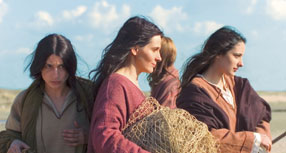
    Few actors are famous in the way that Juliette Binoche could claim to be. Whilst the people on the street are largely ignorant of both her and her work (save perhaps Chocolat), many of those in the art film crowd know that Binoche’s contribution to a film is reason enough for them to see it. It’s not surprising, then, that much of the publicity and discussion for Abel Ferrara’s Mary has focussed on her, particularly as she is playing the title role. Hence there has been plenty of talk about Binoche’s role as Marie Palese, an actress who is inspired by her role playing Mary Magdalene in a Jesus movie and so heads to Jerusalem in search of spiritual enlightenment.

    However, the star of this imaginary movie, is charismatic actor turned director, Tony Childress (Matthew Modine). It's clear that Childress has also funded and produced the movie himself, in exactly the manner he desired, regardless of the storm of criticism it has attracted. As such, he is clearly fashioned in Mel Gibson’s image. Childress’s film, This is My Blood, may be as unconventional as Gibson’s film was ultra-traditional, but the parallels are clear. When Childress jokes that the reason he made the film was "because that Gibson movie made like a billion dollars" we sense director Abel Ferrara underlining the similarities whilst simultaneously poking fun at the inevitable rush to cash in on the success of The Passion.

    One of the interesting things about the film is that it's hard to tell what sort of film This is My Blood actually is. Indeed, we see very little of it. The opening scene of Mary appears to be lifted straight from Childress's movie, only for the next scene to suggest that this was actually Marie Palese's dream. Later on, a dreamlike shot of Palese gives way to what appears to be another scene from the movie. Since the vocals are introduced first, over the top of this footage of Palese, it initially suggests that this too is only in her mind. Yet this scene is immediately followed by one of a TV presenter informing his audience that they have just witnessed a clip from the actual movie.


    Hence it is difficult to know exactly how much of the movie is shown. At best, only five scenes from the movie are included – and two of these may simply be in Marie Palese's, mind. Of the other three, two are taken solely from the non-canonical, Gospel of Mary. Thus, the only scene from the film that definitely is taken from the Gospels is that of Jesus washing the disciples' feet. And the sound accompanying this clip is not even from Childress's fictional movie, but from an academic explaining how this act demonstrated Jesus's message of love.

    So, the majority of the film remains a mystery. How much is from the canonical gospels? The Gospel of Mary is very short, certainly not long enough to be the basis of a feature film, how greater part does it play, and what does the rest consist of. Furthermore, what are the offensive elements in the film? It is criticised both by some Jewish groups on grounds of anti-Semitism, and some Christians because it departs from orthodoxy. Is it even meant to be a good film? The Jesus it portrays is horribly miscast, but is that Childress's fault or Ferrara's? Interestingly, Childress frequently repeats the message that his critics should see the movie before they offer criticism, yet, in stark contrast to, say, Jesus of Montreal we are given only a fleeting glimpse of it to make up our own minds.

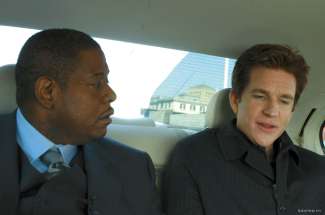
    Childress's movie, however, is only a small part of the overall story. The main story, is about the spiritual journey of Ted Younger, played by Forest Whitaker. Younger chairs a national TV program discussing religious issues for a mainstream audience, grilling various experts from academics to religious leaders. He is deeply ambivalent about his faith, both publicly and privately, and the film implies that this is amongst the reason his show is such a success.


    Ted knows neither of the other two main characters at the start of the film, but when he sees the movie at a press screening, he decides to try and interview them both for his programme. Childress is naturally keen to promote his movie, and agrees fairly readily. Palese, however, has been settled in Jerusalem for a year, and is reluctant to return to anything to do with acting. Younger is only able to get hold of her because he has been having an affair with Gretchen, one of Palese's friends.

    This sparks a series of three phone calls between Ted and Marie. The first begins with Ted trying to get her to appear on his show. Marie is evasive, preferring to turn the conversation around to her recent spiritual insights. Initially, Ted is left unimpressed by Marie's statement that "Jesus helped Mary Magdalene, and s/he’s helping me now". Yet, strangely, when his personal life runs into problems, he finds himself calling her up to discuss them. Younger is clearly in need of redemption. "I’ve done so many bad things" he later confesses and whilst he’s no Bad Lieutenant we see enough of his behaviour to be unable to deny his self-accusation.

    Director Abel Ferrara manages to draw impressive and complex performances from all three actors. Binoche's final scenes are shot without sound, yet convey the process of her finding peace wonderfully. Modine swaggers about with a driven self-importance and yet somehow connects you to his suffering despite his arrogance, and self-centredness. Quite what Ferarra is trying to say by having this character play Jesus is unclear, but it's a fascinating question that in and of itself raises a number of possibilities. Whitaker gets the most screen time and delivers a remarkably nuanced performance which gains greater and greater depth with repeated viewings. His final scene touches on something that is rarely shown in modern cinema taking the narrative deeper when most directors would have been content to have finished. There is also an impressive supporting performance from Heather Graham, as Younger's wife, Elizabeth. Graham plays against type, and this works to great effect.


    All in all, Mary marks a return to form for Ferrara. In addition to an interesting premise, a strong script and a number of excellent performances, he also infuses the film with energy, wit and vitality. At times his tongue seems firmly in his cheek, and yet that never detracts from the film's gravity. Elsewhere, quirky sound and vision editing add a sense of mystery and uncertainty, whilst the cinematography manages to capture the atmosphere of late-night introspection and isolation perfectly.

    Unorthodox theories about Mary Magdalene have gained great prominence in the last few years. Yet most of the discussion has focussed on the history surrounding Mary Magdalene, and the early Christian communities that both developed and were, no doubt, ultimately defined by the Gospel that bore her name. Mary takes things in another, arguably more mature direction, refusing to concern itself with the details of her life after the resurrection, the alleged minimisation of her role in church history, and the suppression of the gospel that bears her name. Instead it suggests that any such community would have been primarily recognised as followers of Jesus, with any identification with Mary being very much secondary. Hence the film ultimately examines how those that have identified with Mary and/or have been inspired by her (whether past, present or future) might impact those around them with the message of the one she followed.

    Labels: , ,