


First Temptation of Christ (2019)
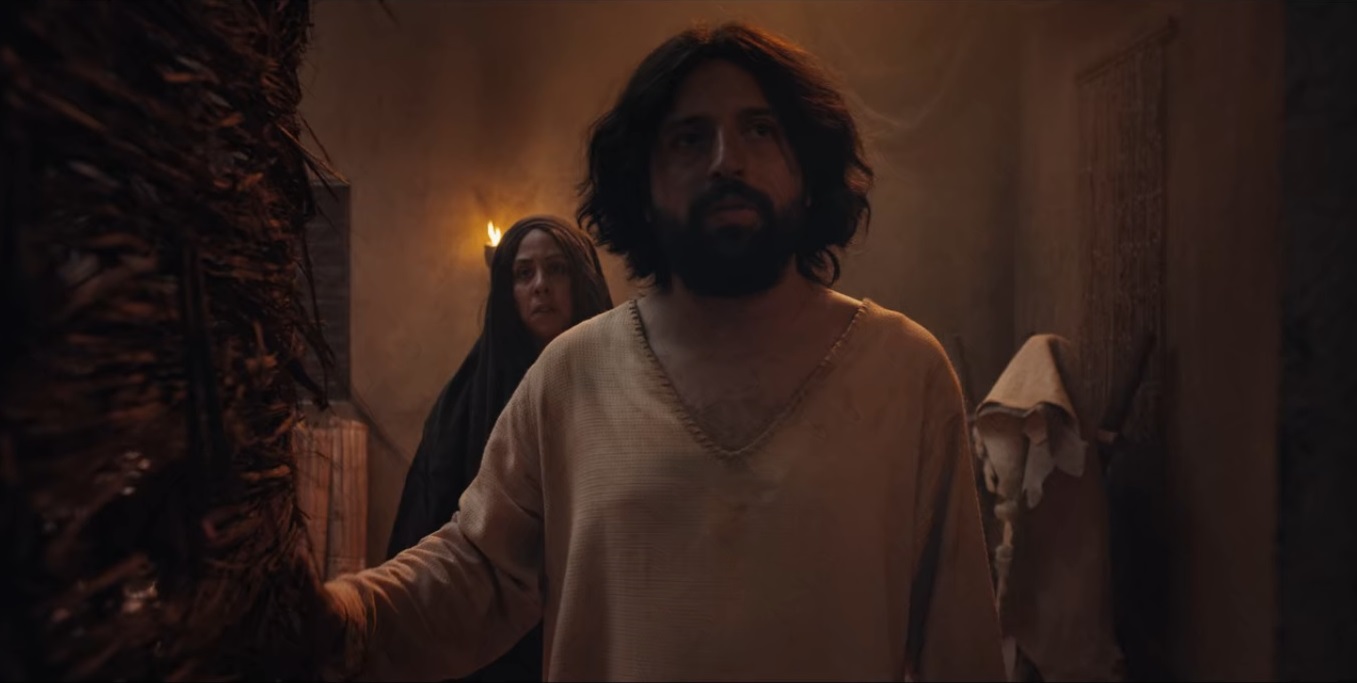
Last Christmas Netflix brought us it's first self-produced Bible film - The Last Hangover and it appears to have been enough of a success that they have commissioned (what I suppose must, these days, have to be called) a prequel from the same Brazilian comedy troupe Porta dos Fundos. As with that film, First Temptation is an anything-goes, neo-bawdy comedy which is happy enough to offend anyone who streams it without somehow knowing what to expect. Peter Chattaway describes it as "intentionally blasphemous" noting that he is using the word "descriptively, not pejoratively". In short if you are likely to be offended by this, stay away.
Those who enjoyed Last Hangover may well find this is an improvement. Whereas Last Hangover felt like a sketch (skit) dragged out for 46 minutes, the structure here is much stronger. Even if the plot goes in a somewhat bizarre direction, it is much more discernible and holds together the jokes and the craziness. It does make it harder to describe, however, without giving away too many spoilers.
Jesus returns from forty days in the desert to find Mary and Joseph have thrown him a surprise 30th birthday party, but he has brought his own surprise, a friend he has met in the desert. It's one of those set-ups where the pair's romantic attachment is clear to the audience, but goes over the characters' heads. Orlando (played by Fábio Porchat, who played Jesus in the first film) is the epitome of the positive homosexual stereotype. He's the kind of life-and-soul-of-the-party type who the other revellers find eminently likeable and who can enter a room of sheltered types and win them over even before they have realised his sexuality.
Meanwhile Jesus (this time played by Gregorio Duvivier) is only just discovering his origins for himself. When God turns up unexpectedly for the party ("he said he wasn't coming") there's tension between him and Joseph and the three take Jesus to one side to explain to him his origins. Jesus is confused and disappointed ("I want to specialise in juggling") but things begin to pay off when he realises he can perform miracles. Given the glut of films in recent years showing characters discovering their supernatural powers and then practising, adjusting to and (only eventually) mastering them there is much more comedic potential here than the writers manage to extract. If Spiderman, Harry Potter and various other superhero movies can play these moments for laughs in essentially serious productions then the potential comic seam here seems sadly under-mined.
Later on Jesus has a vision caused when he drinks Joseph's Glaucoma tea, which spoofs other religious figures though somewhat conveniently Allah has just wandered off for a moment. I imagine some people might get angry at the comparatively more more reverent treatment of Allah, but given the Charlie Hebdo shooting one can hardly blame them.
It's always difficult to assess the success of comedy in another language. So much humour depends on nuances of language, tone, delivery and referencing that things that are hilarious to a good percentage of people from the original culture may not amuse other audiences at all. For my part, I found the occasional laugh, but couldn't really endorse it on that front. Nevertheless, those who appreciated the original for anything other than it's taboo-breaking chutzpah, will probably enjoy more of the same here. Netflix now have a number of bought-in biblical productions available to stream. It will be interesting to see what will happen if they ever get around to producing a more serious effort of their own.
Labels: Comedy
posted at 8:35 am © Matt Page 2005-2026


2 Comments:
At 6:43 pm, December 17, 2019, Michael said…
"I imagine some people might get angry at the comparatively more more reverent treatment of Allah, but given the Charlie Hebdo shooting one can hardly blame them."
I doubt that Porta dos Fundos views Brazil's tiny Muslim minority as a lethal threat. It's more likely that they're more respectful to Allah than Jesus because it is the church, not Islam, that has loomed large in Brazilian life since colonization. The Catholic Church and Evangelicals wield enormous power in Brazil. The current president of Brazil is a theocrat. It's not hard to understand why the guys who made the film are more interested in poking fun at Jesus - and by extension the church - than satirizing the Islamic faith.
At 10:38 pm, December 17, 2019, Matt Page said…
Oh absolutely, yes. The whole film is about Christianity which is understandable for the reasons you say. But the section in question does poke fun at the Buddhist and Hindu faiths (also minority fairhs in Brasil), but explicitly avoid doing the same to Islam.
Post a Comment
<< Home