• Bible Films Blog

    Looking at film interpretations of the stories in the Bible - past, present and future, as well as preparation for a future work on Straub/Huillet's Moses und Aron and a few bits and pieces on biblical studies.

    100 Bible FIlms book cover featuring Russell Crowe as Noah from the 2014 film Facebook logo    Twitter logo   BlueSky logo  

    A picture of me from a few years back a white man with blond hair and a short red beard
    Name:
    Matt Page

    Location:
    U.K.

    Ecoadaptations book cover
    FIlm aas an expression of spirituality book cover
    Movies From the Mountaintop book cover
    100 Bible Films book cover
    T&T Clark Handbook of Jesus and Film book cover
    the bible onscreen in new millennium book cover
    T&T Clark COmpanion to the Bible on Film book cover
    The Bible in Motion book cover
    Encyclopedia of the Bible and its Reception book cover
    Screengrab from The Passion:Religion and the Movies
    Screengrab from The Passion:Films, Faith and Fury

    Sunday, July 12, 2026

    Was Goliath a giant? Height differences and Saul

    Jonathan and David behind a huge looking Saul. Three shot from waist. Blue backgroundImage from David (2025)
    Somewhere before I've made the following point about the height comparison between Saul and Goliath, but I can't seem to locate where so I'll lay it out again. While most translations of the Bible still give Saul's height as "six cubits and a span" (around 9'6") this is because either they are too old to know better, or because – often in contravention of their stated approaches to ancient manuscript selection – they prefer to preserve "tradition" over best practice.

    One of the few exceptions here is the NRSVUE (even the earlier version of the NRSV get this wrong). It gives Saul's height as "four cubits and a span" (around 6'6"). A footnote states "Q ms Gk: MT six". This means that there are variations here between manuscripts. The Masoretic text (MT) gives the height as six cubits and a span, but both the Dead Sea Scrolls text (Q) and the Greek Septuagint text (Gk) give the height as just four cubits and a span. Because "we" ave known about the Masoretic text the longest, it's the one that became the standard, but since then we have discovered the older, (therefore written closer to the original) Dead Sea Scrolls text. 

    Sorry if that's a bit complicated, but essentially, faced with two older texts that say Goliath was four cubits and a span; and one more recent text that say it was six cubits the most likely scenario is that the doubly attested shorter Goliath is the closer match to the original text. This is particularly true given (as many David films have amply demonstrated) later adaptations have a tendency to exaggerate the story to make it seem more exciting and/or give God/David more credit. It's really hard to imagine a scenario where anyone would want to the tell the story making the giant seem shorter.

    The thing is that if Goliath really were only 6'6" this does change the story a lot, because Goliath was not the only tall person on the battlefield that week. 1 Sam 9:2 describes Saul as being "head and shoulders above everyone else". It's hard to give a precise figure from such a malleable description, but it would suggest he was also well over 6 foot and more importantly he was also in a special category size-wise.

    In other words, perhaps the point here is that this was meant to be Saul's fight. Goliath was the Philistine's champion and he calls out Israel's champion, their super tall warrior, their best fighter (as was fairly typical of tribal leaders in those days). He calls out Saul. But Saul is has a crisis of confidence. He fails to trust God (in contrast to David). It's just another way in which the text wants to shame Saul and glorify David. And I suppose the way the textual translation of the text has gone has softened that criticism of Saul a bit through time. Even a 6'6" man would baulk at fighting a man who is perhaps even 9'9". And perhaps given Saul clearly had very poor mental health, maybe cutting him some slack (even if through the medium of poor translation) is not the worst thing in the world.

    Labels: ,

    Sunday, February 02, 2014

    Saul e David (1964)

    Saul e David by Italian director Marcello Baldi is a much undervalued member of the Bible films canon. So much so, in fact, that despite it having sat in my film library for many years I had to be reminded of it recently by Witlessd.

    The image above occurs near the end of what is for, for me, the finest shot in the film, and indeed one of the finest in any biblical film. It's from the scene in 1 Samuel 26 when David spares Saul's life for a second time. Only we don't yet know it. The previous shot of Saul's camp in the distance, it's lights twinkling in the darkness of the night fades into a slow panning shot of the hills. As the pan continues Saul's camp emerges in the foreground and the camera tracks past sleeping soldiers before pausing momentarily on Abner's face, and then on Saul who lies asleep with his water jug at his side. It pans again along Saul's body until it encounters his javelin and the feet of someone standing over him. A slow pan upwards reveals the face of David. It's a sublime shot, not quite on a par with Orson Welles' start to A Touch of Evil but certainly worthy of being mentioned in the same breath.

    Director Marcello Baldi was a stalwart of Italian "Peplum" films. Other entries on his CV include Goliath and the Dragon (1960) and I grandi condottieri (1965 - a.k.a Gideon and Samson) so he was familiar with filming this type of material. (He also did a great deal of second director work). However here he transcends much of the cheesy Son of Hercules vs Venus type material to focus on the more intimate story of Israel's first two kings†.

    The film relies largely on Norman Woodward's performance as the troubled king. Some have found the performance to be over the top, others have found it powerful and sympathetic, but certainly it is an intimate performance that tries to understand Saul's paranoia, desperation and faltering faith. Gianni Garko also puts in a good performance as David too. Outwardly he cuts a heroic figure, his blond good looks and confidence winning audiences as well as almost everyone who comes into contact with him. But Garko manages to convey a great deal with his eyes. Again the shot above displays both his love for Saul, but also his sorrow that his King still wishes him dead.

    What's interesting about David's heroic stature is this was previously the role held by Saul. Few films really attempt to portray this, but Saul e David captures it brilliantly in the opening scene. As Saul arrives back at camp following his victory over the Amalekites the people swarm round him . It is clear he is their hero. Saul himself is seemingly swept away by their euphoria. When Saul arrives to chastise him for not following God's commands to the latter, Saul expresses his doubts that Samuel even hears God. The scene ends with Samuel declaring "you will grow smaller and smaller" and with that the film cuts to a series of quick shots of huge tents being collapsed as the army prepares to return home.

    The heroic link between Saul and David is emphasised when the Saul first encounters the young shepherd boy. "You're the ghost of my boyhood come to mock me" mutters Saul to the blond, almost golden skinned, child that stands before him. David's puniness casts a stark contrast with Goliath in one of the rare occasions that a David film portrays the giant at what would seem to be around 9'6". It's also one of the bloodiest befellings of the man from Gath, with blood spurting almost comically from his forehead.

    From then on the story focusses on Saul's obsession with David and his perceived threat and superiority. It's an intimate portrayal which really draws out the tension in Saul's family (Michal, Jonathan) which only serve to twist the knife.


    =====
    †Technically, amongst the northern ten tribes Saul's remaining son Ish-bosheth was the second king, ruling for two years before he was ousted by David, but that doesn't flow as well. Interestingly there is a reference to this at the end of the film. As Ish-bosheth witnesses the battle being lost he reminds Abner of his promise to protect him which he does. As they ride away Saul's other sons are killed and Saul falls on his own sword.

    Labels: ,

    Saturday, February 01, 2014

    Saul, Depression and The Bible Pt 4


    I have a great deal of sympathy for King Saul. I've experienced depression myself and have several close friends who have also struggled with it, so it, no doubt, makes me empathise with those whose minds trouble them.

    It would be foolish, of course, to try and place a precise diagnosis on someone who is, essentially, just a character in a book. We only have a very small part of the picture and the writers hardly sympathise with whatever the mental troubles are that so afflicted Israel's first king, nor do they have any sort of expertise in mental health. Indeed they, like most people of their time linked mental health problems to demon possession. Yet whilst scholars are becoming more comfortable aligning, say, some of the 'demoniacs' that Jesus 'exorcised' with epilepsy, there seem precious few revisionist takes on Saul.

    Saul, was a young and tall man when he was, rather surprisingly, anointed king of Israel. He was not at all prepared for the role - his family amongst the lowest in Israel - but found himself thrust into the limelight with only the resentful Samuel as his mentor. Yet despite the odds against him, he unites Israel and wins a string of key victories over the enemies that had been afflicted him. The result? The kingship is torn away from him on a couple of technicalities and he never sees his guide and mentor again. He slides into an affliction so deep that the court worries about how to help him. Fearing he is cursed, he dithers when faced with Goliath (who according to some manuscripts may only have been a little taller than Saul) and sees another young man from a humble background to fight in his place. David's victory is decisive, but propels him to greater popularity than even his king.

    We don't really know why Saul threw the spear at David. It's unlikely to be justified, but the sources all seem to favour David, despite his desertion to the Philistines, and so it's possible that the accounts of subsequent events are less than fair to Saul, but his reaction to David sparing his life is both an interesting contrast to the madman who we so often see depicted and a sign that sadness and humanity remained in his heart. His last acts smack of despair. Faced with a revived Philistine army, in desperation he consults a medium in the hope of reaching Samuel. Saul's worst fears and realised. The battle is lost. His sons are killed. He takes his own life.

    The above is not meant as a serious historical account, nor as a neatly comprehensive Bible study. It's simply offered as a more sympathetic take on Saul - a man whose great potential was destroyed by his troubled mind.

    I've been mulling this piece for a long time, perhaps almost a year since I first saw The Bible's fourth part. Various films treat Saul more or less badly. In some such as Rei Davi he is clearly stark, raving mad. In others, such as The Story of David he is played more sympathetically.

    The Bible's account is interesting because on the one hand it wants to stick closely to the text. It doesn't really want to appear historically inaccurate by allowing Saul to foam at the mouth. Yet on the other hand it goes to considerable length to cast Saul in a very poor light. In addition to the inclusion of all the major low points in Saul's life, the are three overarching ways in which his failings are highlighted / exaggerated: dialogue, storytelling licence and visual representation.

    Dialogue
    As a series The Bible often uses paraphrased / invented dialogue but uses archaic sounding language to give it an air of authenticity. This is particularly true of the narrator whose authoritative voice lend the production the additional impression of credibility, particularly as the series first broadcast on the History Channel.

    In the fourth part of this series the narrator adds various bits of dialogue that emphasise and exaggerate Saul's failings. When Saul is condemned for not destroying Agag and the Amalekite animals the narrator concludes that "in trying to please his men Saul has displeased God". Later on he tells us that Saul is now "obsessed with destroying David".

    When The Bible's characters speak it is a mix of the semi-archaic and modernised dialogue, but it too is used to paint Saul in a poor light, emphasising his paranoia ("he'll want my crown next". "He wants our crown, can't you see?") as well as the extent of his problems ("Father! What demons posses you?"). There is also a good deal of mad/paranoid shouting at various points in the episode.

    Storytelling Licence
    All visual interpretations of the Bible involve a degree of artistic licence, but the ways in which the narrative varies from that in 1 Samuel is fairly telling, frequently painting Saul in a worse light that the biblical text. An early example is the first time Saul attacks David. In the Bible Saul throws his spear at David, just before he goes on to allow him to marry his daughter. It's a moment of insanity, but in the Bible it occurs when David returns from de-foreskinning 200 Philistines and Saul still appears to be brooding about the failure of his plan to endanger his future son-in-law. Later when Michal protects David by claiming he is ill, it's Saul himself who barges into Michal's room, rather than sending one of his men. It implies a kind of driven madness that is simply not their in the biblical account.

    Another occasion when the programme pushes a little beyond the biblical account is when David "spares" Saul's life. In both accounts of this in 1 Samuel Saul repents and calls David his son. In the first account (ch.24) he even weeps. In this film however Saul remains annoyed and angry about the incident and shows no remorse. Finally, Saul's suicide in 1 Samuel happens as Saul is fleeing and pressed hard by the battle. He seems to kill himself to avoid the punishment that the Philistines mete out to his corpse instead. Here however when Saul takes is own life he is under no particular pressure certainly not in the heat of battle.

    Visual Representation
    A few of the techniques used here also make Saul seem less sympathetic. The first is that the actor chosen to play Saul is far less attractive that the actor who plays David. There is only 4 years between the two men but whereas Langley Kirwood who plays David seems hunky and youthful, Francis Magee, who plays Saul, seems old an haggard. Magee's demeanour doesn't really help matters, he sneers and hardly ever smiles.

    The camera-work also adds an extra dimension here. Saul is often shot using a hand-held camera, for example in one scene when he is tossing and turning on the bed. Later on he prays and this time not only is a hand-held camera used it is held at a low angle and extremely close up, giving a real air of madness to Saul's attempts to reconnect with God.


    I'm not sure why this episode stuck in my mind as it did. Perhaps it is just the way that for all the things that are going on around him Magee manages to find some humanity in Saul and help us find some pity for him. But perhaps it's just the way in which a number of small changes all pointing in a certain direction seem to go above and beyond what seems, to me at least, an already harsh assessment in the pages of 1 Samuel.

    =======

    Whilst I'm here I noticed a few other things in this issue not relating to the main issue discussed above. The first is when David enters Jerusalem a hero and petals rain down on him from the buildings above. It's noticeable for two reasons, firstly I'm not sure we know about the kind of buildings the Israelites were living in at this point - they had yet to conquer Jebus - but this kind of multi-storey courtyard seems a little far-fetched. It's also noteworthy because this shot is repeated (I believe) in a later scene where one of David's descendants (Jesus) also parades into a city and is greeted by a shower of petals. Later Jesus enters the same courtyard on the way to Golgotha, but this time is only treated with derision. Again, if memory serves the raining petals motif is something borrowed from Last Temptation of Christ.

    Speaking of visual nods to Bible films gone by, there is an awful lot of similarity between the wooden screens Bathsheba gets changed behind in this film and in 1951's David and Bathsheba. Interestingly Bathsheba is also involved in the scene where the ark is brought into Jerusalem. It takes a bit of re-arrangement to make this happen (in 2 Samuel David's affair with Bathsheba is five chapters after the ark has been brought into the city), but it does throw fresh light onto why David's dancing was undignified and why his first wife, Michal, was not best pleased.

    Labels: , ,

    Thursday, July 18, 2013

    The Kingdom of Israel: Part 2


    One of the most interesting things about the Hebrew Bible is the emergence of different voices offering conflicting opinions, sometimes even within the same book. Arguably one of the most divisive issues in this respect seems to be the role of Israel's kingdom in relation to God's will and plan. The solemn warnings by the prophet Samuel at its inauguration take a very negative view of kingship whereas the rules of David and Solomon are idealised even despite their personal faults. By the later period of the kingdom the focus has shifted again. The main issue is no longer whether or not having a king is the right path, the key question is the manner in which the king walks along that path.

    This varying status is complicated by the length of time between the events described and their final editing into 1 & 2 Samuel and 1 & 2 Kings. The length of time covered by these books is roughly around 500 years, even before other questions around authorship and so forth are examined.

    Disappointingly, very few biblical films examine the morality of Israelite monarchy as an institution, preferring instead to focus on individual rulers within the Kingdom of Israel and issues surrounding their lives. Indeed the most significant examination of this question occurs not in a Hebrew Bible film, but in one about Jesus; Roberto Rossellini's Il Messia (1975). Rossellini's focus here, as in many of his films, is on power and it's abuse, and so the scene where the elders of Israel persuade Samuel to create a monarchy is pivotal in showing the abuse of power in Israel and how Jesus comes in the opposite spirit. His Messiah is cut from a different cloth.

    The potential for the corruption of the monarchy system is illustrated in other ways however, namely the depiction of Saul and his fall from grace. This is particularly well embodied in Orson Welles' portrayal and the inaugural Israelite king in Saul and David. Whilst the quality of the film is poor, Welles' heavy, sweaty body evokes memories of his earlier role as corrupt cop Hank Quinlan in A Touch of Evil (1958). The impression of corruption and decay is only heightened by the cheap and poorly lit throne room set and the generally amateurish feel of the production as a whole.

    As might be expected, other films also portray Saul in a harshly negative light. Whilst a modern day therapist might look at the story of Saul and see a man troubled by mental health problems, filmmakers tend to be less specific. One notable example being 2013's miniseries The Bible. There, even in his early days as a hero Saul comes across poorly raising his crown to the sky at his coronation like a victorious sportsmen lifting aloft his new trophy. It's notable as well that in a film packed with actors bearing typicall rugged, American good looks, Saul's face is far less attractive. Indeed, few films demonstrate much empathy for Saul, a tradition that goes all the way back to the early silents David and Goliath (1908), Saul and David (1909), David and Saul (1911) and Death of Saul (1913).

    This is quite in contrast, however with the general depiction of his successor, David. The majority of David films introduce us to him before he becomes king, and focus on him as a young man, notably before the trappings of power have corrupted him. This enables the audience to sympathise with him, meaning that, where presented, his later failings are somewhat rendered more understandable.

    The most notable exception to this trend is 1951's David and Bathsheba. Whilst the film does encourage sympathy with the king, not least by casting Gregory Peck in the lead role, it's focus is almost entirely on David's latter years. His heroics against Goliath, a time when he was purer and more in touch with his god, are preserved only as a late flashback as David reflects on where it all went wrong. It nicely highlights the recurring, but subtle minority report of Saul/Kings, that power corrupts the ideals of youth.

    Nowhere is this clearer than in the story of Solomon who in his youth choses God's wisdom over riches, but ends up pursuing the latter, ultimately bringing his kingdom to the verge of bankruptcy a weakening te tribal confederation to the verge of breakdown. Such a story though is far less appealing and so films have tended to focus on the more glamourous aspects of Solomon's reign, most notably the visit of the Queen of Sheba and the implied romance in La Reine de Saba (1913), Solomon and Sheba (1959) and The Bible Collection: Solomon (1997). Whilst the damage that is done by Solomon's pursuit of wives, concubines and the political power this affords him is included in certain films, such as 1997's Solomon, generally these aspects are amongst the less memorable moments of the films.

    It would be Solomon's son however who oversaw the disintegration of the kingdom of Israel, but none of the major productions treat it as anything other than a contextual footnote on the narrative arc of another story. The divided kingdom features, primarily in the handful of films about Elijah - Athaliah, Queen of Judah (1910), Sins of Jezebel (1953), Living Bible: Elijah a Fearless Prophet (1958) and Testament: Elijah (1996) - but is perhaps best captured by the 1936 film Green Pastures where instead of portraying one particular king, it condenses them all into a single king who has set his face against God and persecuted the generic prophet who speaks out against him.

    And it is through the lens of the prophets that cinema witnesses the fall of Judah (although the destruction of the northern kingdom of Israel is absent in a Hollywood history of the world), most notably the story of Jeremiah, although perhaps also the films about Judith (see Judith, film). Two major productions tell the story of Jeremiah - the fifth 'hour' of the The Bible miniseries (2013) and the 1998 biopic Jeremiah. Whilst both have their faults, not least the earlier film's mawkish love story, they also capture the chasm that has gradually appeared between the monarchy and leadership of the Jewish nation, and their supposed God. The warnings of Samuel have come to pass and Israel is about to be stripped of her monarchy forever. The two films chronicling the last days of Judah focus not on the waning monarchy, but of the rising prophets. The 1998 film is far more concerned with the ins and outs of Jeremiah's life, his struggles with God, than on the inner workings of the seat of power. Part of that focus is also on the more depressive aspects of Jeremiah's personality as manifest in his walk with God, this creating a fascinating contrast with the mental health problems of Saul. Whilst the cinematic corpus on the kingdom of Israel shows humans remaining flawed the pendulum has swung from kings to prophets, and Samuel's initial warnings about the corruption of royal power have been amply demonstrated.

    Labels: , ,

    Monday, January 31, 2011

    Testament: David and Saul

    Give the average quiz show host the category "The Bible" and ask them to complete the following - David and          - and you'd get the same answer every time. Indeed the working title for Scott Derickson's proposed film about events from the books of Samuel even omits David's name, opting simply for Goliath.

    The giant everyone loves to hate does feature in Testament's David and Saul, but he's a relatively minor figure. Even David is not the film's greatest concern. The film might even have been called Saul and David - it's Israel's first king that is the leading character in this production, rather than his more famous successor.

    I remember very little of David and Saul from my first viewing roughly eight years ago. It certainly didn't make much of an impression. This time around however it was quite different. Eight years on it seems like a complex and striking examination of a man fighting his demons. Whether or not "demons" should be taken literally perhaps accounts for the difference in my reactions to my two viewings of this film. Then I was open to the idea that when the Bible said demons it may, on occasion, simply be talking about something like epilepsy. Now I would tend to assume some form of health issue was what was being mentioned even if I remain open to the possibility that occasionally something supernatural might be responsible.

    That the film is primarily about what is going on in Saul's head is apparent from the opening scene. Instead of seeing David in the fields chasing lambs, or wistfully playing his harp in the countryside, we start with Saul raving in his throne room. The location shot tells us that it's night, and it slowly pans up a dark rocky outcrop before reaching a foreboding prison-like castle at the top. The throne room itself is also dimly lit and sinister music accompanies Saul's deep seated paranoia. At the mention of Samuel's name there's a flash back to the last meeting between the two, king and prophet.

    Samuel himself is a shadowy figure in this film. Dressed in a dark, hooded, robe he only appears in flashbacks, voices in Saul's head and as an ghostly apparition at the witches cave in Endor. Even Samuel's anointing of David is made highly ambiguous - David certainly doesn't realise he has been appointed king.

    By placing Samuel's confrontation of Saul in the midst of this scene of his madness manifesting himself, there's an implication that it is this incident which is the cause of Saul's condition, be it mental illness or spiritual affliction. It's never entirely clear which way the filmmakers understand it. Certainly the characters in the film believe it's the latter, as is consistent with their world-view but the content of the film itself - aside from the narrator's opening mention of Saul being "seized by an evil spirit" - makes a fairly strong case the other way.

    It's not until after this scene that David makes an appearance, killing a bear, playing for the king, being outraged by his countrymen's cowardice in the face of Goliath and then volunteering to slay the Philistine giant. But even as Goliath is hitting the floor, Saul is haunted by Samuel's voice in his head: "Another man, a better man than you...". This leads into a montage of David's victories, his adoration at the hands of the crowd and the evident love Saul's children have for him. Each moment is accompanied by Samuel's same words, "Another man, a better man than you...". One particularly enjoyable visual moment here is a pan across a stone relief depicting David's victories.

    David continues to play to soothe Saul's turmoil and Saul attempts to kill him. David flees and Saul hunts him down. Whilst in his pursuit Saul hears of Samuel's death, hears the prophet's voice "we shall never meet again" and decides to outlaw consulting with the dead. The next scene is of David sneaking into Saul's camp and stealing his spear.

    The final part of the film deals with Saul's death. His armies face the numerically superior Philistines and being unable to hear God's voice he seeks out the witch of Endor. Samuel's ghost appears - it's a highly ambiguous portrayal, Samuel's form is transparent and shrouded in green mist. The battle goes on and Saul and Jonathan die. The camera lingers on their dead bodies still upright and greyed out as if they are statues already yesterday's men being commemorated.

    This is the true end of the film. There is a final scene but it's an epilogue accompanied only by the narrator's voice. David is crowned in the bright sun. It's pretty much the sun has been seen in the film. The occasional scene has been shot during the day, but the majority of it is portrayed at night, and dark colours dominate the film, particularly where Saul is concerned. The visuals throughout are striking actually. It would be easy to write off David and Saul as a mere cartoon, particularly as it lacks the expressionism of other films in the series, but the animation is far superior to most hand-drawn films: a true work of art. The use of colour is very strong, particularly the contrast between Saul and David, but also the evocative backgrounds, doing for this film what the scenery in so many westerns does for them.

    David and Saul may not be a conventional take on the film, but it's all the better for it. Instead of a typical story of the underdog, it's a complex examination of the descent into darkness - mental or spiritual - of Israel's first king, and certainly the finest exploration of Saul that I have seen.

    Labels: , , ,

    Friday, March 03, 2006

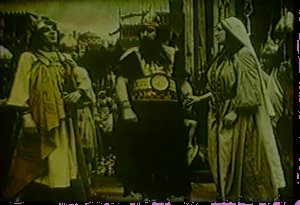
    Early films about David and Saul (1911-1913)

    The final films on the DVD I've been discussing this week are both about the Hebrew King Saul; David et Saul (David and Saul) made in 1911 and La Mort de Saül(The Death of Saul) made two years later in 1913.

    These films are also made by Pathé Frères and not listed in Campbell and Pitts' "The Bible on Film". They do list two other related films David and Goliath (1908) and Saul and David (1909), which is also listed on the IMDB . What is unusual about these two films is the subject material they choose to handle, particularly given that only a couple of films based on 1 Samuel had been made by this point. I imagine if you asked a modern day viewer which episodes from the books of Samuel they were most familiar with they would firstly list David and Goliath, and then perhaps David and Bathsheba, or the calling of Samuel, or the anointing of Saul or David. I'm not sure whether it's a sign of how much the parts of the bible we focus on have changed so much in 95 years, or that, even upon its release, they were unusual choices. Suffice to say none of the above scenes are in either of these films, the details of which are below:
    David and Saul (1911)
    David returns from beating the Philistines - (1 Sam 17/ 1 Sam 18:27)
    David marries Michal - (1 Sam 18:27)
    Saul grows jealous - (1 Sam 18:6-9)
    David feigns madness whilst in hiding - (1 Sam 21:10-15
    Saul slaughters the priests - (1 Sam 22:6-18)
    David hides from Saul - (1 Sam 23:24-28)

    Death of Saul (1913)
    Saul slaughters the priests - (1 Sam 22:6-18)
    The Witch of Endor - (1 Sam 28)
    The death of Saul - (1 Sam 31:1-6)
    What we do see is a great deal of attention given to Saul ordering the killing of the priests of Nob, which appears in both films. The review of The Death of Saul at IMDb notes how:
    "The story of David and Saul is an interesting and ambitious choice of material, and this short feature does a creditable job of filming it. The story has plenty of action, plus some significant psychological themes, and this movie succeeds in bringing out at least some of both."
    In my opinion the most successful biblical films have been those that use less familiar material to challenge our pre-conceptions, or are at least more concerned with trying to explore their protagonist's motives.

    A few notes:
    It's interesting that the first film starts with a celebration of David's victory over the Philistines. I put chapter 17 as a possible reference, but that's probably just re-coiling from the fact that the most likely victory this refers to is the one where he gives 200 Philistine foreskins to Saul as a wedding dowry (1 Sam 18:27). Certainly the fact that at the end of the scene Saul holds David and a very un-cinematic Michal together indicates that it is this victory which is being celebrated.

    Although this film doesn't actually show the incident where David chooses not to kill Saul when he had the chance, it does refer to it in the intertitles "Fatigued Saul seeks repose in the cave where David was hidden". However, instead of seeing David cut Saul's cloak or steal his spear, the scene following this intertitle seems to portray David hiding on the other side of the mountain (1 Sam 23:24-28). The film crams a lot in, in a very short time, and it's hard for the viewer - even if they have a good knowledge of the various stories - to work out what is being depicted.

    The break between the two films on the DVD I have is very slight, and most of the scant discussion of these two films on the web seems to treat them as one. In fact I noticed that the title of the film, placed at the top of each intertitle, changed before I noticed the briefly shown intertitle card that announced the new film.

    The second film is two years later, and the filmmakers have significantly improved in that time. The use of a red colour wash during the sacking of Nob is quite effective, as is the use of special effects when Samuel appears in the witch's cave. There's also a really impressive scene (coming soon) where a large crowd of Philistines rush past the camera into the battle. Except for the old black and white celluloid
    the way this action is filmed is on a par with anything today, and is the most impressive sequence I can recall at any point before Birth of a Nation revolutionised film in 1915.

    It is interesting how the second film paraphrases Saul's prophesy into three clauses and then shows each happening in turn:
    "Thy armies shall be delivered into the hands of the Philistines
    Thy sons shall perish
    Thy sword shall avenge the God of Israel"
    It's not quite what Samuel says (1 Sam 28:19), but the way the film takes each clause and shows it happening is a far more sophisticated narrative device than was standard for the era.

    Finally, although the second film is about the same length as the first it takes things much more slowly. The emphasis here seems to be much more on Saul and what is happening to him internally, than the events that are happening around him. It also allows a chiastic structure to the events. The film starts with Saul destroying the priests of Nob, and ends with him being destroyed by them, separated only by an announcement of God's judgement upon him, and linking the two actions nicely together.

    Matt

    Labels: , , , , ,