• Bible Films Blog

    Looking at film interpretations of the stories in the Bible - past, present and future, as well as preparation for a future work on Straub/Huillet's Moses und Aron and a few bits and pieces on biblical studies.

    100 Bible FIlms book cover featuring Russell Crowe as Noah from the 2014 film Facebook logo    Twitter logo   BlueSky logo  

    A picture of me from a few years back a white man with blond hair and a short red beard
    Name:
    Matt Page

    Location:
    U.K.

    Ecoadaptations book cover
    FIlm aas an expression of spirituality book cover
    Movies From the Mountaintop book cover
    100 Bible Films book cover
    T&T Clark Handbook of Jesus and Film book cover
    the bible onscreen in new millennium book cover
    T&T Clark COmpanion to the Bible on Film book cover
    The Bible in Motion book cover
    Encyclopedia of the Bible and its Reception book cover
    Screengrab from The Passion:Religion and the Movies
    Screengrab from The Passion:Films, Faith and Fury

    Monday, November 23, 2015

    The Bible in Motion: A Handbook of the Bible and Its Reception in Film


    Editor: Rhonda Burnette-Bletsch
    Publisher: Walter de Gruyter
    Date: February 15, 2016
    Language: English
    Length: 900 pages*
    Price (Hardback/eBook): £180/$335
    ISBN: 978-1614515616

    It gives me great pleasure to announce the release of this two-volume work on the Bible in Film. A large part of the pleasure comes from the knowledge that two of the chapters in it will be mine, but also it looks set to be the the most comprehensive work on the subject to date with work from most of the leading scholars in this area. First here's the official blurb from the publisher's website:
    This volume contains a comprehensive collection of original studies by well-known scholars focusing on the Bible’s wide-ranging reception in world cinema. Part I examines the rich cinematic afterlives of selected characters from the Hebrew Bible and New Testament. Part II considers issues of biblical reception across a wide array of film genres, ranging from noir to anime. Part III features directors, from Lee Chang-dong to the Coen brothers, whose body of work reveals an enduring fascination with biblical texts and motifs. Part IV offers topical essays on cinema’s treatment of selected biblical themes (e.g., redemption, lament, apocalyptic), particular interpretive lenses (e.g., feminist interpretation, queer theory), and windows into biblical reception in a variety of world cinemas (e.g., Indian, Israeli, and Third Cinema). This handbook is intended for scholars of the Bible, religion, and film as well as for a wider general audience
    Based on the proofing copy I have seen it seems that his information is a little out of date. For a start it's now split into two volumes, with six parts in total. *Secondly, whereas the data in circulation at the moment suggests that it will be 710 pages, I suspect the final manuscript will be pushing 900. I've excerpted the contents pages below

    I have one chapter in each volume. In the first I have an essay on the depiction of (King) David in film a character who has, hitherto, been rather overlooked by Bible film scholars. But I'm particularly proud of my contribution to the second part, a chapter on Roberto Rossellini. Rossellini is such a great, influential, but - these days - under-appreciated film-maker that it feels like a real honour to write about him. I've been learning some Italian, as much spurred on by my appreciation of his films, and I'm quite looking forward to being able to say I've been published on Rossellini.

    It's also a tremendous honour to be published alongside so many of the writers whose work I have appreciated over the last 15 or so years as well as getting the chance to encounter some new (to me) names as well.

    At 710-900 pages and £180/$335 a copy it's hardly for the casual reader (Amazon even gives it's weight as 1.7lbs!) and I imagine most copies will end up in academic libraries. Still I imagine if it sells well there may be a paperback release at some stage at a substantially lower cost. Certainly if you do get a chance to get hold of a copy I would strongly recommend it.

    VOLUME 1
    Part I: Biblical Characters and Stories (Hebrew Bible)

    1. In the Beginning: Adam and Eve in Film
    - Theresa Sanders
    2. Noah and the Flood: A Cinematic Deluge
    - Anton Karl Kozlovic
    3. It’s all in the Family: The Patriarchs of Genesis in Film
    - Peter T. Chattaway
    4. The Cinematic Moses
    - Jennifer L. Koosed
    5. Samson and Delilah in Film
    - J. Cheryl Exum
    6. There Might be Giants: King David on the Big (and Small) Screen
    - Matthew Page
    7. Esther in Film
    - Carl S. Ehrlich

    Part II: Film Genres and Film Media
    8. Scripture on Silent Film
    - David J. Shepherd
    9. Film Noir and the Bible
    - Robert Ellis
    10. The Bible Epic
    - Adele Reinhartz
    11. Western Text(s): The Bible and the Movies of the Wild, Wild West
    - Robert Paul Seesengood
    12. Mysteries of the Bible (Documentary) Revealed: The Bible in Popular Non-Fiction and Documentary Film
    - Robert Paul Seesengood
    13. From Skepticism to Piety: The Bible and Horror Films
    - Mary Ann Beavis
    14. “Moses’ DVD Collection”: The Bible and Science Fiction Film
    - Frauke Uhlenbruch
    15. The Word Made Gag: Biblical Reception in Film Comedy
    - Terry Lindvall and Chris Lindvall
    16. Drawing (on) the Text: Biblical Reception in Animated Films
    - R. Christopher Heard
    17. Anime and the Bible
    - Fumi Ogura and N. Frances Hioki

    Part III: Biblical Themes and Genres
    18. God at the Movies
    - Rhonda Burnette-Bletsch
    19. Satan in Cinema
    - Peter Malone
    20. Creation and Origins in Film
    - Gaye Williams Ortiz
    21. The Book of Job in the Movies: On Cinema‘s Exploration of Theodicy and the Hiddenness of God
    - Reinhold Zwick
    22. Lament in Film and Film as Lament
    - Matthew S. Rindge
    23. What Lies beyond? Biblical Images of Death and Afterlife in Film
    - Sandie Gravett
    24. This is the End: Apocalyptic Moments in Cinema
    - Tina Pippin

    VOLUME 2
    Part I: Biblical Characters and Stories (New Testament)

    1. Jesus and the Gospels at the Movies
    - W. Barnes Tatum
    2. Women in the Cinematic Gospels
    - Catherine O’Brien
    3. Judas as Portrayed in Film
    - Carol A. Hebron
    4. Jews and Judaism in Bible Films
    - Clayton N. Jefford
    5. Paul and the Early Church in Film
    - Richard Walsh
    6. Mythic Relevance of Revelation in Film
    - Meghan Alexander Beddingfield

    Part II: Cinemas and Auteurs
    7. David Wark Griffith: Filming the Bible as the U.S. Story
    - Richard Walsh
    8. Alice Guy Blaché and Gene Gauntier: Bringing New Perspectives to Film
    - Carol A. Hebron
    9. Oscar Micheaux’s Within our Gates: Emergent History and a Gospel of Middle-Class Liberation
    - Nathan Jumper
    10. Cecil B. Demille: Hollywood’s Lay Preacher
    - Anton Karl Kozlovic
    11. Reframing Jesus: Dreyer’s Lifelong Passion
    - Caroline Vander Stichele
    12. Luis Buñuel: Atheist by the Grace of God
    - J. Sage Elwell
    13. Robert Bresson: Biblical Resonance from a Christian Atheist
    - Sara Anson Vaux
    14. Roberto Rossellini: From Spiritual Searcher to History’s Documentarian
    - Matthew Page
    15. Federico Fellini: From Catholicism to the Collective Unconscious
    - Marie-Therese Maeder
    16. John Huston: The Atheistic Noah
    - Gaye Williams Ortiz
    17. Stanley Kubrick: Midrashic Movie Maker
    - Nathan Abrams
    18. In the Wake of the Bible: Krzysztof Kieślowski and the Residual Divine in Contemporary Life
    - Joseph G. Kickasola
    19. Peter Weir: Man of Mystery, Mysticism, and the Mundane
    - Anton Karl Kozlovic
    20. Cheick Oumar Sissoko: West African Activist and Storyteller
    - Rhonda Burnette-Bletsch
    21. Lee Chang-Dong: Exploring the Hidden Christ
    - Fumi Ogura and N. Frances Hioki
    22. Mark Dornford-May: Transposing the Classic
    - Samuel D. Giere
    23. Serious Men: Scripture in the Coen Brothers Films
    - J. R. Daniel Kirk
    24. Liberative Visions: BiblicaL Reception in Third Cinema
    - Antonio D. Sison
    25. The Reception of Biblical Films in India: Observations and a Case Study
    - Dwight H. Friesen
    26. “A Ram Butts his Broad Horns again and again against the Wall of the House”: The Binding Myth in Israeli Film
    - Anat Y. Zanger

    Part III: Voices from the Margins
    27. Judaism and Antisemitism in Bible Movies
    - Adele Reinhartz
    28. Ethnicity and Biblical Reception in Eve and the Fire Horse
    - Stephenson Humphries-Brooks
    29. A Slave Narrative for the “Post-Racial” Obama Age
    - Rhonda Burnette-Bletsch
    30. The Temptation of Noah: The Debate about Patriarchal Violence in Darren Aronofsky’s Noah
    - Erin Runions
    31. Gay Male Villains in Biblical Epic Films
    - Richard A. Lindsay
    32. Imperialism in New Testament Films
    - Jeremy Punt

    ==============
    *This is based on the number of pages in the proofing copies I have seen. Final version may differ significantly.

    Labels: , , ,

    Thursday, October 06, 2005

    Genesis Films

    This is an article I wrote for the Open Heaven Church website back in the days before this blog really existed. It's likely that the article will disappear from that site shortly, so I thought I ought to repost it before it disappeared forever.
    ===
    Noah's Ark 1928
    Of all the events narrated in the Bible, perhaps the hardest to picture, let alone understand, are those in Genesis. Whilst there have been several attempts by filmmakers to capture these formative events on celluloid, their most productive time was actually back in the silent period. The most comprehensive lists cite around 20 films on the various stories made during the silent period, and a further six in the first 10 years of the “talkie” period. By contrast, the past 70 years have only produced a similar number.

    The first film made about a story in Genesis was the French film Joseph Vendu Par Ses Frères (Joseph Sold by his Brothers) made in 1904. Other notable films in this early period included 1928 silent version of Noah’s Ark (where allegedly some people actually died filming the spectacular flood scene[1]), and The Green Pastures (1936) a child’s daydreamed version of the stories she is hearing in Sunday School.
    The Green Pastures (1936)
    The Green Pastures was probably the first film to portray God, and certainly the first to portray him as a black man. Unsurprisingly the Ku Klux Klan were outraged and protested causing many theatre owners to refuse to show it. The Genesis scenes, being seen through a child’s imagination make no attempt to be realistic, but their gentle humour, and basic simplicity give the film a spiritual authenticity that is absent from the majority of these films.
    The Bible (1966)
    Perhaps the best known Genesis film was made by John Huston in 1966. The Bible looked at the first 22 chapters of Genesis, starting with a wonderfully filmed creation sequence (voiced by Huston himself), and progressing through to Abraham and Isaac. The Bible was made at the end of the golden era of the biblical epic, and wisely avoids making this into a spectacular but camp, bathrobe drama. Instead its dark lighting gives much of the film a strange sense of the dawn of time, and the primitive nature of the cultures involved.
    The Bible (1966) - backstage shot
    At the same time the literalism of the presentation will both find favour with those who take a more literal understanding of the “how” questions of creation, whilst also giving it the air of archetypal myth that adopt a more symbolic interpretation.
    Genesis Project  -The Bible: Genesis (1979)
    The Bible was the last Hollywood film based on the Old Testament for over 30 years, with the exception of Richard Gere’s 1985 turn as King David, (replete with his undignified monkey dancing in front of a returning Ark of the Covenant). Instead most bible films began to be made for the TV and the church market. Typical of this was the late seventies “Greatest Heroes of the Bible” series, which included the stories of Noah, The Tower of Babel, Sodom and Gomorrah, Abraham, Joseph. Around the same time the American organisation Campus Crusade (who made the 1979 Jesus film) made Genesis. This was a word for word, bland narration of the whole book accompanied by fairly uninspiring images which lasted for four long hours. It’s biggest plus point was it’s use of Middle Eastern actors, but it’s no surprise that none of them subsequently became the new Omar Sharif.
    Mrinal Sen’s Hindi adaptation - Genesis (1986)
    The eighties were a dry old time for cinematic versions of the book. Only the intriguingly titled Italian film Adam and Eve: The First Love Story and Mrinal Sen’s Hindi adaptation of the first five chapters were even made.
    The Bible Collection - Abraham (1994)
    The nineties were a different matter. With Phil Collin’s namesake rock band out of the way, the bible’s opening tome was back in business. Whilst there were many Genesis movies made over that decade the majority were made by the Italian-American based company Lux Vide. Lux Vide put together 11 Old Testament stories as part of their “Bible Collection”, which also includes three New Testament films Jesus, Paul and The Apocalypse (my review), as well as four largely fictional spin offs, (each loosely based on a marginal New Testament character). Four of the Old Testament episodes were based on the events in Genesis - Creation and Flood, Abraham, Jacob and Joseph, and all four have their points of interest. Abraham, Jacob and Joseph frequently pierce the Sunday School cocoon that surrounds many tellings of these stories, both in cinema and other media, by including stories such as The Rape of Dinah, and Judah and Tamar that are so awkward, real, embarrassing and controversial that they are usually excluded completely. And the performances of Richard Harris, Sean Bean and Ben Kingsley respectively are usually worth watching in their own right.
    Genesis: Creation and Flood (1994)
    Of the four, Genesis: Creation and Flood (1994) is possibly the jewel in the crown. Certainly it is strikingly different from the more traditional and straightforward tellings of the story that the other films give us. Instead of attempting to emulate the pattern of the earlier The Bible, or of the other films in the series, Genesis: Creation and Flood sets it’s own course. Covering the first eight and half chapters the film shows us the stories through the eyes of an old man telling his grandson the history of his people. Paul Schofield narrates in all but a few passages, only occasionally interrupted by a female counterpart.

    The narration is accompanied by a striking series of images, occasionally interspersed by shots of Grandfather and the child, and other members of their family. It is an unusual effect. As Peter T Chattaway notes how normally you would be able to “follow any film's basic narrative thrust with the sound turned off… Genesis would fail that test”.[2]  In other words the narration shapes how the images are perceived. In a sense, this is like the act of creation itself, bringing form and order to the otherwise chaotic and unintelligible. The slow pacing of the film also gives it a meditative feel, enabling the audience to let the images wash over them whilst highlighting the words that drive them, and bring them meaning. This relaxed pace also brings a level of internal calm and thus transports the viewer to another time and another place far more effectively.

    Ultimately then Creation and Flood is far more poetic than any of it’s predecessors, and it is ironic that a film which is essentially driven by such a narrative and literary work is ultimately so unliterary and poetic as a final product. It’s also interesting how the stress here on the story being passed down from generation to generation reflects the oral tradition that preceded and underlies the written text we have today.
    In the Beginning (1999) - Martin Landau
    Another film that takes this community narrative approach was a made for TV movie In the Beginning (2000). Martin Landau headed up a strong cast, playing Abraham; just four years after he had played Abraham’s grandson Jacob in the aforementioned Joseph. At over three hours, In the Beginning had plenty of time to cram in a number of these stories, and as a result, it could afford to continue well into Exodus. The creation scene here is also told by way of a flashback, but the sequence is so overloaded with explosive special effects, and cheap modern documentary footage it completely strips the event of its mystery and gravitas.
    Noah's Ark (1999)
    The end of the millennium brought with it a flood of biblical stories, and Genesis films were no exception. Chief amongst the offenders was another TV movie Noah’s Ark (1999), which was almost as unwelcome as the events it depicts. It is difficult to imagine what motivated the production of this film. Its attempt to weave futuristic elements into a pre-historic myth backfires more spectacularly than a seventies Robin Reliant. The bizarre futuristic elements evoke Kevin Costner’s mega flop Waterworld. Had that film been a success this at least could be called a cheap cash in, but as it was a commercial disaster that cannot have been the driving factor. Similarly terrible is the ludicrous attempt to pass off its idiotic amalgamation of the stories of Lot and Noah with the ridiculous off-hand comment “by the time they finish the story of Sodom and Gomorrah they will probably say we weren't even there."

    The only potential merit of the film is that it solves the debate on God’s foreknowledge for ever. Noah’s Ark is so bad that if God had known the flood would spawn this stinker, he may have opted for another method of world destruction, (or at least have made sure that this was destroyed along with everything else). Frankly, it deserves every “wooden acting” joke that critics can throw at it.

    Another poorly executed Genesis film is the straight to video Prince of Egypt  prequel   Joseph King of Dreams. The film does have some good points, notably the dream sequences which certainly benefit from a more creative and more expressive medium. However, the tiresome songs quickly become so dull that ultimately you begin to wonder if a spell in prison like Joseph’s might be far preferable.
    La Genese (1998)
    Perhaps the best Genesis film of recent years (and of all time) is Cheick Oumar Sissoko’s La Genèse(1998). Sissoko’s film tells the story of Abraham’s family from an African perspective, and as a result, it is recorded in the Bambara language of Mali, spoken by only few million people. As a result La Genèse understands the nomadic tribal context in which these stories are set, far better than any number of  Hollywood films, and brings with it a number of fascinating insights.
    La Genese (1998)
    It also refuses to lionise its protagonists, and emphasises just how dysfunctional this family was at times. Too often these characters have been stripped of their humanity, and shown simply as one dimensional heroes. La Genèse gives a more realistic picture which honours the God who uses such ordinary, broken unreliable people to further his will, and offers us hope that he can use us as well.

    La Genèse is also beautifully filmed capturing the wonderful landscapes, and capturing something of the empty space that typified the world several thousand years ago. Nevertheless, at times the film is very stark and brutal in what it captures – starring unflinchingly at some of the more earthy elements of the story.
    La Genese (1998)
    It’s the ability of this film to bring a new angle to well known and familiar stories that makes it so valuable. There have been many films on the various Genesis stories, but only a handful bring something insightful, interesting or challenging. Of these three stand out in particular. The Bible (1966) simultaneously shuns the worst excesses of the 50s and 60s Biblical Epics whilst subverting some of the genre’s standard features. La Genèse (1998) brings the tribal context to the fore, exploring the stories with an authenticity that is largely absent otherwise. Finally, Genesis: Creation and Flood (1994), offers us the chance to reflect on scripture anew as it draws attention to the poetic nature of the text.  


    [1] Various reports of this, the best online can be found at www.jimusnr.com/Noahsark.html

    [2] www.canadianchristianity.com/cgi-bin/bc.cgi?bc/bccn/0501/artvideos

    Labels: , , , , , , ,

    Wednesday, December 16, 2015

    The Seven Ages of Bible Films


    Over the years there have been various books and articles written on the development of Bible films some of which have attempted to sub-divide the material in some way. Whilst some have done this thematically (e.g. Adele Reinhartz's "Jesus of Hollywood") the majority have sought to present films in chronological order and then, if they have attempted to sub-divide them at all, have tended to go by decade (e.g. Kinnard and Davis' "Divine Images").

    However, the more I think about this subject the more I find that whilst the by-decades approach might work well in certain contexts, it doesn't work as well as it might in others. So I'd like to propose a new sub-division into seven periods which link the films to both social forces outside of the industry but also to do with key developments directly related to particular Bible films and their reception.

    I think the history breaks down into these categories fairly naturally, but it's kind of nice that it breaks into seven - a number with far more significance in the Bible rather than say eight or six. But I'd be interested to hear what people think about this - both the number of eras and the points of transition from one to the next. Anyway, enough pre-amble - here they are:

    The Early Silent Era
    No shocking revelations as to where to start this initial period, but I'd suggest that this era runs through the various series of films from Pathé, Gaumont and Vitagraph to the first "feature length" films such as Olcott's From the Manger to the Cross (1912) and Griffith's Judith of Bethulia (1914). However it would be another film from D.W. Griffith, Birth of a Nation, that launched a new era in silent film in general such that his follow up would mark the start of a new period.

    From Intolerance to the End of the Silent Era.
    Whilst some would argue Griffith's work is not as influential as is sometimes claimed, Intolerance was an important film for Bible movies. Before it they were largely small, pious affairs adapting the stories from the Bible in a fairly simple manner. Afterwards they became grand spectacles, like the works of DeMille and Curtiz. And when the silent ea ended Bible films went back into their shell for a little while.

    The Early Talkie Period
    The first talkies largely bypassed the Bible. The depression meant that the large budgets now required were no longer so readily available; industry regulation clipped the wings even of films which served up their overt sexuality with a morality tale. And then World War Two started and budgets tightened still further. A few notable Bible films were made in this period chief among them Golgotha but it was not until 1949 that a new Bible film would really make a splash.

    From Samson and Delilah to Greatest Story Ever Told
    The fourth period is often dubbed the Golden Era of Bible films, but that is perhaps to give too little credit to earlier periods when biblical films did tremendous business. Nevertheless, DeMille's 1949 epic Samson and Delilah triumphed at the box office and suddenly everyone wanted to make, and watch, a Bible film. It worked well for about ten years, aided by the arrival of widescreen aspect ratios, but by the time that King of Kings was released in 1961 the tide was beginning to turn and 1965's The Greatest Story Ever Told put the final nail in the coffin. John Huston's The Bible squeezed through after that, but to no better results, and it is very much a part of this era rather than the one which would follow the fall of the big-budget biblical epic.

    The Experimental Period
    The failure of the traditional, largely faithful adaptations of the Bible resulted in an unprecedented time of creative freedom, as filmmakers were freed from the restraints of having to appeal to the widest possible audience in order to get a decent return on their huge budgets. Whilst a few conservative and traditional films snuck through during this period, the more controversial films that were released during this period speak for themselves - Jesus Christ Superstar, Godspell, Il Messia, Life of Brian. Last Temptation of Christ and Jesus of Montreal. Eventually though religious groups began to organise themselves in protest against what they perceived as an attack on their beliefs. The campaigns went off the scale with Last Temptation and even lowish budget but controversial films like that became too risky.

    The Millennial Period
    The impending arrival of the new millennium brought with it an increase of interest in the man at the centre of the celebration. This combined with the pressures brought upon studios led to the arrival of a whole host of more faithful, but (largely) less artistically challenging adaptations. The Bible Collection tweaked the story round the edges, sometimes trivialising the story somewhat, but it became the most extensive selection of film based on the Bible. Not far behind it was the Visual Bible's word for word adaptations of Matthew and Acts. Whilst a few more creatively interesting films got made (The Cross, The Miracle Maker) and the odd more controversial film (Book of Life) still got through overall the tone was fairly traditional a move that came to a head with the 2004 release of The Passion of the Christ, in many ways the epitome of this move to a more traditional portrayal of the Bible on film.

    After The Passion of the Christ
    To say the runaway success of The Passion of the Christ was unexpected is an understatement, but it lead to two different groups of people seeking to make Bible films, but with largely disappointing results (from both a creative and financial point of view). One the one hand were conservative Christians trying to get Hollywood to finance their pet projects. A huge proportion of the films announced failed to make it onto the big screen and those that did were panned by critics. On the other were the money men, who smelt the opportunity, but lacked the necessary understanding of the landscape that was required to make money. There were a few successes - The History Channel's The Bible drew better than expected audiences - but overall he two groups failed to find projects that would satisfy both their objectives. Typical of this phenomena is 2014's Noah - too experimental to do well with Christians, yet too biblical to do well with fans of Aronofsky's previous films, the film failed to find a big enough audience. No surprise then that 2015 and 2016's seem to have approved with lower budgets but only needing to appeal to a more niche demographic in order to make a return on its investment.

    It will be interesting to revisit this post in the years to come to see if, and indeed when, a new era arrives and in which direction if moves.

    Labels: ,

    Monday, October 17, 2016

    The Canon in the "Experimental" Era


    This is the latest in a series of posts about the relationship between the Bible, the idea of canonicity and film.
    The "Golden Era" of Bile films ended with a series of perceived failures leading the major studios to be cautious about investing more money into opulent epics that were unlikely to provide a good return, yet amongst writers, directors, evangelists and actors there was no shortage of interest in adapting the Bible. This led to a more experimental age. Forced to work with lower budgets, filmmakers devised more creative ways to explore the biblical text. Furthermore, liberated from the pressure of having to recoup massive budgets, meant that filmmakers no longer had to aim for the middle-of-the-road lowest common denominator. They could more boldly pursue their own artistic vision, pose their own questions and explore issues that more mainstream movies simply could not risk.

    The difference between these two eras is perhaps most starkly illustrated in the contrast between the Jesus movies of the two ages. 1965 The Greatest Story Ever Told (dir. George Stevens) was a big budget, yet respectful and deferential, epic which presented a Jesus who conformed to, rather than questioned, the establishment view of Jesus. Just eight years later, three very different Jesus films were battling it out at the box office, all with startling different portrayals of Jesus, all of which had clearly departed from the traditional funding model.

    The most famous of the three films was Jesus Christ, Superstar. Superstar started life out as a single in 1968, which then led to a concept album (1970), and then to an arena tour and wildly successful theatre productions on both sides of the Atlantic.1 Thus by the time the film was released in 1973 there was already a ready made audience for the film, and indeed much of the phenomenal support that the previous incarnations had enjoyed, transferred to the movie. As a result the production's portrayal of Jesus - as a visionary who loses his way in the adulation that accompanies his growing popularity - was able to be far more radical than anything that had preceded it and whilst it was set in the Israeli desert it blurred the boundaries between Roman Judea and modern-day America.

    In a not dissimilar fashion, another musical - Stephen Schwarz's Godspell - also appeared on Broadway in the early seventies before being adapted for the silver screen. Here however the adaption was more innovative from a formal angle setting the story firmly in modern-day New York and dressing Jesus and his disciples in clown suits. Whilst the film's theology was not quite as radical as Superstar, it nevertheless ended the film without a traditional resurrection scene (which is present in both stage-shows in a fashion at Jesus's gleaming reappearance at the final curtain).

    The third Jesus film of 1973 is also one that is primarily about the music, The Gospel Road (dir. Robert Elfstrom) starring Johnny Cash. This film also relied on an unconventional funding model and utilised a combination of star-power and enthusiasm amongst religious groups to bring in its audience. Whereas Superstar and Godspell had used their degrees of liberty to offer unorthodox takes on the gospel narratives, The Gospel Road used its relative freedom to push a more overtly evangelistic agenda. This was even more the case with Jesus (1979) which was specifically produced with an evangelistic use in mind. The very same year the most controversial film to portray events from the gospels was released. Monty Python's Life of Brian, which followed the character Brian of Nazareth whose life coincided at key with that of his town's most famous citizen, proved hugely controversial on its release for it's supposedly blasphemous portrayal of Jesus. The following decade two even more unconventional films about the life of Christ emerged - Martin Scorsese's Last Temptation of Christ (1988) and Jesus of Montreal by Denys Arcand. Not all cinema releases chose such an unconventional path; King David (dir. Bruce Beresford, 1985) was arguably less, rather than more, controversial than its 1951 predecessor David and Bathsheba.

    The move of biblical films to outside of the mainstream was also reflected in the range of countries which made films during this period. If Hollywood's golden era had also been reflected in a growing interest in countries further afield, that tendency only increased during the late sixties, seventies and eighties. In particular in Europe where Greece, Hungary, Czechoslovakia, and the Netherlands all released their maiden Bible films. However, many of these productions were not made to be viewed in cinemas, but at home on their respective television networks.

    Whilst television had emerged during, and perhaps even been a catalyst for, the golden age of Bible films, it was in this period that it really came of age as a medium for producing biblical films. There are a number of notable trends in this respect. Firstly that, at times, television could be far safer even than the epics of the major studios. Programmes made by commercial channels seeking to gain an even higher audience for their advertisers, not only had an incentive to take fewer risks, but often needed to break stories down into bite-sized pieces such that commercial breaks could interrupt the programme regularly. This was not always the case, of course, Rossellini's two New Testament productions - Acts of the Apostles (1969) and The Messiah (1975) - are fine examples from a director who was convinced of the artistic importance and potential of television. It's interesting to note however that in an era that served up Jesus Christ Superstar, Life of Brian and The Last Temptation of Christ that the Jesus film that drew the widest audience was Franco Zefferelli's made for TV Jesus of Nazareth.2

    The other notable trend in this era was that it gave filmmakers the potential for to explore their given subject at far greater length. Sometimes this is with regard to the length of time available for just one story, such as Zefferelli's Jesus of Nazareth, but other times it allowed a greater number of stories, covered as separate episodes. The Greatest Heroes of the Bible series, for example, spanned 17 episodes including lesser covered stories such as Joshua, the Tower of Babel, Daniel and Esther.

    Another series was produced during this time frame that also covered multiple episodes. The similarly named The Greatest Adventure: Stories from the Bible contained seven stories from the Hebrew Bible, but rather than being produced for the cinema or live action television they were cartoons which came to prominence more through their release on video. This was the start of a new trend which came to expand greatly over the final two eras.

    But whilst some of these series might have covered some of the stories that had proved less popular, for the first time the number of stories being adapted for the first time almost became non-existent. Muharrem Gürses' Nemrud (Nimrod, 1979) may have been the first director to have made a film about the man frequently associated with the building of the Tower of Babel, but the story itself was first covered in 1921's La Sacra Bibbia and more recently in Hustons' 1966 film The Bible: In the Beginning as well as the aforementioned episode from The Greatest Heroes of the Bible series.

    Indeed only one story that had not been covered before was given its first outing during this period; The story of Tamar, Er, Onan and Judah was covered in the Italian/German/Swiss production La salamandra del deserto, released in English speaking countries as Tamar, Wife of Er (dir. Riccardo Freda, 1970). Whilst this is doubtless due to the sheer quantities of biblical stories that had been covered previously it does also suggest that by this stage the "canon" was beginning to close.

    =============

    1 - This is widely attested but this 2012 interview sums it up nicely and is worth a read anyway.
    http://www.telegraph.co.uk/culture/theatre/theatre-features/9556486/Andrew-Lloyd-Webber-interview-the-second-coming-of-Jesus-Christ-Superstar.html
    2 - It's worthin noting however that the production team behind Jesus of Nazareth had earlier been involved in producing the rather more revisionist Moses the Lawgiver which perhaps goes someway to explaining the controversy the project faced in its earliest days, despite the fact it was ultimately to provide a rather bland portrayal.

    Labels:

    Friday, April 10, 2020

    Reflections on "Popular Visual Media and the Bible" Conference


    As someone who is not a paid academic attached to an institution I don't get to go to many biblical studies conferences so it was a real bonus to be able to attend this one. Due to covid-19 the original conference in Exeter was rearranged as an online conference. There was a fair bit of apprehension as to how this would all work, but I think it's fair to say the organisers, Rebekah Welton (University of Exeter) and Zanne Domoney-Lyttle (University of Glasgow) did an excellent job not only in getting everything working seamlessly, but also in making things easy for those presenting papers. These things are hard enough to do in person, let alone when you can't even see if a speaker is "in the room". The result of the smooth running of the conference meant that people actually began to reflect on the fact that for this particular conference the online version was fairly appropriate (given the subject matter), though the networking and chats between sessions was the obvious casualty. Still it'd be great for the planet, and those with more limited budgets, if a result of this online success was more conferences offering good remote options in future.

    Session 1 featured Siobhan Jolley (University of Manchester) and Laura Carlson Hasler (Indiana University) looking at two recent hit comedies. In “I can’t be physical with you” – Reimaging John 20:17 through Fleabag" Jolley drew out rather well the similarities between the never formally named protagonist of Fleabag and the reception of Mary Magdalene, cover both biblical texts and their artistic outworkings. The quote from the session's title was linked with Jesus saying "Touch me not" in John 20:17 and other comparisons were made such as "Fleabag does not want to be part of the Christian community; she just wants to be close to the priest". There were also observations about how such comparisons and fresh interpretations "can make space in the text". For me, it also got me wondering about how Fleabag's famous looks to camera have something in common with the author of John's occasional interjections, particularly as some have used the designation "the disciple whom Jesus loved" as a reference to Magdalene. I'm not sure I'll ever read/hear John 21:25's "I suppose that even the whole world" in quite the same light again.

    Laura Carlson Hasler had been planning to fly in originally to deliver her paper "The 'Good' Book?: Protestant Television Without the Bible". Her paper offered some interesting reflections both on Netflix's The Good Place and the BBC/Amazon's Good Omens (my comments), particularly the role that physical books seem to play in the series. I won't go into spoilers, but it made interesting use of the term "the Good Book" given the series' title and how, despite the array of ethical and philosophical texts and arguments referred to and shown in both series the Bible almost never features. Yet the worldview the series seeks to escape not only clearly originates in Christianity, but specifically Protestant Christianity.

    After the break there were three sessions again with a strong emphasis on recent television shows which mix religious elements in to their contemporary entertainment. Bea Fones (Durham University) gave her paper on "Daddy Issues: Angelic(Mis)Conceptions and Gender Binaries in the CW’s Supernatural", but sadly disruptions meant I was unable to catch the whole session, and my complete unfamiliarity with the show made it difficult to catch up. There was some good stuff at the end about how may filmed takes on angels adopt a more binary approach to angelic gender than the Bible itself.

    Mat Collins (University of Chester) was next, on one of my favourite topics, Abraham's aborted sacrifice of Abraham. This formed a significant chunk on the talk I gave at Greenbelt Festival in 2009 "Biblical Horror Stories for Children" which is sadly not available for download at the moment (though I can share it with anyone who is interested). Collins' "Subversive Screenings: Rethinking Genesis 22 in Popular Visual Media" looked at three works which subvert the Bible's take: Aronofsky's Noah (2014), a storyline in Lost and this Mitchell and Webb sketch on Abraham. I've written before on the link between Noah and Abraham in my own review, and don't know Lost, but despite being a fan of Mitchell and Webb didn't know that particular sketch which is brilliant as always. I really like Collins' observation that the moral of the story has changed from the Bible's original test-of-obedience, which Abraham passes, to a test-of-morality which, in the modern examples, he ultimately fails. The pre-lunch session saw Rebekah Welton (University of Exeter) presenting on "Sibling rivalries and reconciliation in Supernatural: God, the Darkness and Genesis 1:1-5". Again I'm not at all familiar with the series and unfortunately, again, I was sadly distracted by the day job.

    The conference organisers had stated their intentions to avoid just going back over the biblical epics so while the sheer wealth of recent televisual material justifiably dominated morning's sessions, the post-lunch session always promised to be the most intriguing. In Tom de Bruin (Newbold College) "Reception of the Bible in My Little Pony and Christian Apocrypha" basically looked at how Christian fan fiction created by fans of the show My Little Pony has reflected their Christian theology. De Bruin used the term 'Christian Bronies', and while I can't recall if the term was de Bruin's own or one they had adopted themselves, I was surprised to learn these were often adults. The whole thing was fabulously bizarre, featuring conversion narratives for the characters from My Little Pony, yet somehow de Bruin linked it back to parallels with the way in which some early Christians created their own fictional narratives.

    Stephanie O’Connor (Dublin City University) took on "The Batman and the Bible" looking at religious interpretations of comic book heroes in general and, in particular, contrasting the Dark Knight with the more familiar Christ figure of Superman. Batman is a Christ figure we can identify with. Unlike Superman he is fully human, capable of being hurt, reliant on effort and discipline. But it was host Zanne Domoney-Lyttle's paper that was the real eye-catcher. "Wrestling with the Bible: Crucifixions, Kingmakers and a Monday Night Messiah in Sports Entertainment" - a paper born out of Domoney-Lyttle's husband love of wrestling - discussed the unusual biblical narratives that some networks have adopted. David and Goliath is an obvious one, but also the narrative that led up to the line “Austin 3.16 says I just whooped your ass”.


    For me at least, the final session moved into areas with more serious implications. Tim Hutchings (University of Nottingham) presented "'My Jesus Would Be Chunky' Visualising Virtue and Vice in a Christian Videogame" which examined Scripture Union's surprisingly successful video game / app "Guardians of Ancora". Hutchings research involved actual interviews both with representatives of Scripture Union, who had been involved in the commissioning process, and the game's producers who were contracted to complete the work. Hutchings didn't waste any time getting to his point, showing the above screengrab in the opening minutes. It's a shockingly careless piece of unconscious antisemitism via cultural bias. We can, perhaps, give the games company the benefit of the doubt - while you would hope they would do their research, they're not expected to be experts on the text - but this was a project Scripture Union oversaw and frankly they should know better. Just on this shot alone (and adopting for a moment the SU's position that the Gospel accurately record what actually happened) we can see how this moves away from the actual text in a way that negatively portrays Jewish people and blames them for Jesus death. You have the crowd calling out "Kill him", (not what was said) no nuance as to who these particular Jews are, attractively built roman soldiers and Jewish characters who are somewhat other than that, almost a reversing of the power dynamics at play, and so on. Hutchings' interview excerpts only highlighted the issue - it didn't seem like the huge numbers of Jewish deaths that Christian-inspired antisemitism has contributed too had even been considered - but of course there had been plenty of thought about giving Jesus an appropriately modern-looking hairstyle and so on. One of the SU team involved in the project was actually present and brave enough to add her own perspective. I'm not sure that even then she really appreciated the problems. It shouldn't shock me - I've not always been so aware of these issues and I know plenty of people who are both horrified by antisemitism and yet unknowingly perpetuate it. I guess I just though that Christians in general, and particularly those Christian organisations seeking to promote fidelity to the Bible, had become more aware of the issues.

    David Tollerton (University of Exeter), who himself found the above paper "unsettling", then presented on "Anti-Judaism in English History and the strange moment when Doctor Who appeared to propagate biblical supersessionism". He was looking at the episode from the latest Doctor (Jodie Whittaker) called The Witchfinders (S11E8) where the Doctor materialises in 17th century Lancashire and attempts to dissuade the locals from burning a witch. When they argue "As King James has written in his new Bible,'Thou shall not suffer a witch to live.'", the Doctor counters "In the Old Testament. There's a twist in the sequel. 'Love thy neighbor.'". As Tollerton points out this verse actually originates from Leviticus 19:18 and the portrayal of King James is interestingly anachronistic.

    Finally Holly Morse (University of Manchester) gave her keynote on "Serpentine Saviours and Woke Women: Twenty-First Century Television Goes Back to the Beginning". Morse spoke particularly about Netflix's recent remake of Sabrina and converted me from someone who was not particularly interested in it (I was already a man when Sabrina the Teenage Witch landed in the 1990s) to having it fairly near the top of my TV list. Morse particular drew on Sabrina's reimagining of Eve.

    Morse's paper felt like a good end to an excellent conference. Certainly I wasn't alone in feeling that not only was the overall standard of contributions very high, but that there was a real consistency to them, both in terms of quality and theme. It would be great if something like this were to happen again, and whilst the absence of a real meet-up was sorely missed, as someone who only operates around the fringes of academia, I felt I got to connect with a whole bunch of people who share the same research interests as me. You can follow others' thoughts on Twitter via #VisualBible. Thanks to Zanne Domoney-Lyttle and Rebekah Welton and of course all the speakers who made for a great day.

    Tuesday, August 15, 2006

    Bible Films and their Social Contexts

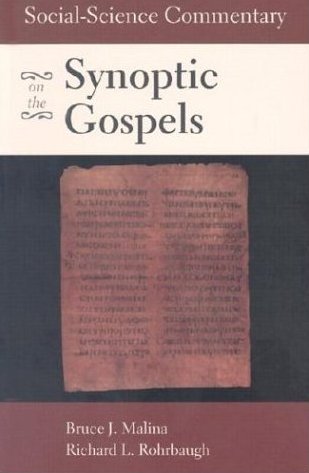
    Tyler Williams posted an interesting piece whilst I was on holiday last week called The Strange New World of the Bible. The heart of the piece is a summary of Bruce J. Malina and Richard L. Rohrbaugh’s "Social-Science Commentary on the Synoptic Gospels", and Tyler lists a number of differences Malina and Rohrbaugh find between our industrial world and the agrarian world of the Bible.
    * In agrarian societies more than 90 percent of the population was rural. In industrial societies more than 90 percent is urban.
    * In agrarian societies 90-95 percent of the population was engaged in what sociologists call the "primary" industries (farming and extracting raw materi­als). In the United States today it is 4.9 percent.
    * In agrarian societies 2-4 percent of the population was literate. In industrial societies 2-4 percent are not.
    * The birthrate in most agrarian societies was about forty per thousand per year. In the Unites States, as in most industrial societies, it is less than half that. Yet death rates have dropped even more dramatically than birthrates. We thus have the curious phenomenon of far fewer births and rapidly rising population.
    * Life expectancy in the city of Rome in the first century BCE was about twenty years at birth. If the perilous years of infancy were survived, it rose to about forty, one-half our present expectations.
    * In contrast to the huge cities we know today, the largest city in Europe in the fourteenth century, Venice, had a population of 78,000. London had 35,000. Vienna had 3,800. Though population figures for antiquity are notoriously dif­ficult to come by, recent estimates for Jerusalem are about 35,000. For Capernaum, 1,500. For Nazareth about 200.
    * The Department of Labor currently lists in excess of 20,000 occupations in the United States and hundreds more are added to the list annually. By contrast, the tax rolls for Paris (pop. 59,000) in the year 1313 list only 157.
    * Unlike the modern world, in agrarian societies 1-3 percent of the population usually owns one- to two-thirds of the arable land. Since 90 percent or more were peasants, the vast majority owned subsistence plots at best.
    * The size of the federal bureaucracy in the Unites States in 1816 was 5,000 employees. In 1971 it was 2,852,000 and growing rapidly. While there was a political, administrative, and military apparatus in antiquity, nothing remotely comparable to the modern governmental bureaucracy ever existed. Instead, goods and services were mediated by patrons who operated largely outside governmental control.
    * More than one-half of all families in agrarian societies were broken during the childbearing and child-rearing years by the death of one or both parents. In India at the turn of the twentieth century the figure was 71 percent. Thus widows and orphans were everywhere.
    * In agrarian societies the family was the unit of both production and consump­tion. Since the industrial revolution, family production or enterprise has nearly disappeared and the unit of production has become the individual worker. Nowadays the family is only a unit of consumption.
    * The largest "factories" in Roman antiquity did not exceed fifty workers. In the records of the medieval craft guilds from London, the largest employed eight­een. The industrial corporation, a modern invention, did not exist.
    * In 1850, the "prime movers" in the United States (i.e., steam engines in factories, sailing vessels, work animals, etc.) had a combined capacity of 8.5 million horsepower. By 1970 this had risen to 20 billion.
    * The cost of moving one ton of goods one mile (measured in U.S.:dollars in China at the beginning of the industrial revolution) was: Steamboat 2.4; Wheelbarrow 20.0; Rail 2.7; Pack donkey 24.0; Junk 12.0; Packhorse 30.0; Animal-drawn cart 13.0; Carrying by pole 48.0; Pack mule 17.0. It is little wonder that overland trade at any distance was insubstantial in antiquity.
    * Productive capacity in industrial societies exceeds that in the most advanced agrarian societies known by more than one hundredfold.
    * Given the shock and consternation caused by the assassination of John F. Kennedy and the forced resignation of Richard M. Nixon, we sometimes forget that this sort of internal political upheaval is nothing like it was in the agrarian world. Of the 79 Roman emperors, 31 were murdered, 6 driven to suicide, and 4 were deposed by force. Moreover, such upheavals in antiquity were frequently accompanied by civil war and the enslavement of thousands.
    Of course this is just the tip of the iceberg, particularly when you consider there was a very different religious and political context which needs to be taken into consideration as well.

    I was reminded of Tyler's post last night when reading some of Jesus's parables in Nikos Kazantzakis' "Last Temptation", and in particular the Parable of the ten Virgins from Matt 25:1-13. There are a whole host of strange cultural practices going on here. For example, what is the role of these virgins? Why is the bridegroom not arriving until a lamp is required? Why are the late virgins locked out? Having recently read Geza Vermes' "Jesus the Jew" (the latest version of which coincidentally features a picture from the film of Last Temptation) I also wonder what exactly is meant by virgin in this context.

    Anyway, it strikes me that these questions are also the ones that face filmmakers looking to make films based on the bible (whether they choose to confront them or not!). The types of bible films we face can, broadly speaking, be split into two camps: those that attempt to show the events in a setting that is apparently the first century (or whichever period the events happened in), and those that offer a more stylised presentation. In the first group of films the challenges are more straightforward, but the success with which the filmmakers answer them is more obvious to casual viewers. In the latter category, on one level it is easy for the filmmakers to "get away" with not considering these questions, but if they are to take them into account they have a far harder task.

    Malina and Rohrbaugh's questions also provide a filter for looking at bible films. For example, simply reading through the bullet points above reminds me of Pasolini's Il Vangelo Secondo Matteo (The Gospel According to St. Matthew - 1964). Pasolini's neo-realist use of non-professional actors taken from agrarian southern Italy feels far more authentic that George Stevens's cast of Hollywood stars (even though both were filmed almost two thousand years after the events they depict).

    The point about more than half of all families seeing one or more parent die during the child-bearing and child-rearing years also stuck out. I cannot recall a film which features Jesus's earthly father Joseph as present during his ministry. I assume this is largely because scripture never mentions him outside the birth and childhood stories (other than verses such as John 6:42). That said, there are a couple of Jesus films which actually show Joseph dying, the longer cut of Jesus of Nazareth (1977) and Jesus (1999). Both films use this event as the catalyst for Jesus to start his ministry.

    Labels: ,

    Monday, October 24, 2016

    The Canon Around the Millennium

    The impending arrival of the new millennium was accompanied by an unprecedented volume of productions in a surprisingly short amount of time. The Golden Era of biblical epics had produced over 90 Old Testament films in just a seventeen year period; the experimental era a similar number in 22 years. But between the start of 1990 and the start of 2004 there were around 120 different productions to gain some kind of significant release based on the Hebrew Bible alone, not to mention the 25 or so films to feature Jesus in some form and a handful of productions based on Acts.

    The numbers of films getting a mainstream cinema release was fairly low. The Prince of Egypt (1998) enjoyed box office success, but no other film enjoyed such a wide release. That said there were many more independent films produced for the cinema. In addition to The Prince of Egypt the three years from 1998 to 2000 also saw the release of Hal Hartley's millennium reflection Book of Life (1998); Superstar (dir. Bruce McCulloch, 1999), featuring comic cameos from Will Ferrell as Jesus; Mary, Mother of Jesus (dir. Kevin Connor, 1999) starring a young Christian Bale as Jesus; and the Welsh-Russian animated collaboration The Miracle Maker (2000) directed by Derek W. Hayes and Stanislav Sokolov.

    Whilst the ever increasing costs of producing successful mainstream movies, for a audience that was perceived - perhaps incorrectly - to be shrinking, meant that big cinematic releases were few and far between, the genre was thriving in other areas. Production arrangements were changing radically, most significantly in the area of collaboration. Television companies from different countries would come together and pool their budgets to produce films that could be broadcast on their different networks at home, often with some dubbed dialogue. Following release they could also be sold on DVD. This was the model used by Luxe Vide for their expansive Bible Collection series which ran to seventeen episodes.

    Another new area of development were films made more for Christian audiences might be broadcast on Christian television networks as well as enjoying a DVD release. Indeed the preponderance of animated series aimed more at children in this era (including The Greatest Heroes and Legends of the Bible (fourteen biblical entries), Animated Stories from the Bible (thirty-six entries) and Veggie Tales, whose more fluid adaptations make them harder to quantify.

    A few years into this period cinema celebrated its hundredth birthday and the centenary of the first Bible film followed a few years later, so by this point, few of the main stories from the Bible had not been covered at least once. However many of those that had only been sparsely covered in the past - not least when compared to their prior significance in the Bible, interpretative teaching from the Bible and church art - began to gain greater coverage. Just as the filmic canon was beginning to be established, it began to be challenged.

    The most significant challenge to the established order was The Bible Collection's 1998 adaptation Jeremiah (dir. Harry Winer). Whilst a few films had touched on the fall of Jerusalem only the 1922 German film Der Kampf um Jerusalem1 had previously given any real significance to the prophet associated with the Bible's longest book.2 Along similar lines the "Animated Stories from the Bible" series produced cartoon versions of Daniel (dir. Richard Rich, 1993) and Elisha: Man of God (dir. Richard Rich, 1994). Daniel was also included as an episode in the Testament: The Bible in Animation series of short films aimed at a more grown-up section of the market. It is undoubtedly significant that all of these projects had strong links with the church and perhaps saw part of their mandate more as popularising the stories of the Bible than continuing cinematic tradition.

    However, there were also filmmakers from outside of Christianity seeking to re-engage with the stories that filmmakers had appeared to forget such as Israeli director Einat Kapach's film Bat Yiftach (Jephtah's Daughter, 1996). One other interesting development in this period was the release of the Liken Bible Series which contained both episodes based on biblical stories and other based on the Book of Mormon such as Nephi & Laban (dirs. Dennis Agle Jr., Aaron Edson, 2003) and Ammon and Lamoni (dirs. Dennis Agle Jr., Aaron Edson, 2004).

    ======
    1 - For an interesting paper about the history about this once unknown, then found "orphan" film read Jan Christopher Horak's paper, "The Strange Case of The Fall of Jerusalem : Orphans and Film Identification"
    2 - Based on number of words in the original language.

    Labels:

    Wednesday, October 23, 2013

    Joseph films for Church Use

    A while back, one of the churches I'm involved with has asked me about good clips for use in a series on Joseph. I've been flat out recently, so I suspect I'm too late to be of any use, but I thought I'd highlight a couple of films that might be useful for churches looking at Joseph.

    Compared to some biblical characters, Joseph hasn't actually had that many films made about him, and there are still a few I need to see. Chief amongst these is 1974's The Story of Jacob and Joseph (sometimes called simple Jacob and Joseph), starring Colleen Dewhurst amongst others, which sits unwatched on my shelves. It's got 7.1 on IMDb suggesting it's better than average for the time, period and subject, but I suspect it probably is still a little too shabby for public use.

    There were a number of silent films on the subject, most notably La Sacra Bibbia (The Sacred Bible): The Story of Joseph in Egypt (my review). The first Genesis film was one about Joseph, the French Vendu Par Ses Frères (Joseph Sold by his Brothers) made in 1904. IMDb turns up a couple of others both from 1914 - Joseph in the Land of Egypt and Joseph's Trials in Egypt. (Campbell and Pitts list date Joseph in the Land of Egypt as 1915). None of these three are commercially available.

    There were then a string on Joseph films in the 1960s, predictably two coming out of Italian studios - Giuseppe Venduto Dei Fratelli [Joseph Sold by his Brothers] (1960), I Patriarch Della Bibbia [The Patriarchs of the Bible] (1963) - as well as a couple of Israeli films - the puppet animated Joseph and his Brethren (1962) and Joseph the Dreamer (1967). The story is also covered by the Living Bible series (1957 - Joseph, The Young Man and Joseph, Ruler of Egypt, ) and the Greatest Heroes of the Bible series (1978 - Joseph and his Brothers).

    However, all these films are probably too dated for modern audiences. Some people in those church groups might find them interesting, but as all generations become increasingly more media literate, the above films seem increasingly archaic and unintentionally humorous. So realistically we need to look to the modern era. A neat division is made here by the absence of any Joseph films from the 1980s.

    Al-Mohager [The Emigrant] (1994)
    Whilst the film's subtitles will mean that this film is probably not going to work for most congregations, it's probably the best of the films about Joseph in my opinion. It's been five years since I saw it, but as I mentioned in my review at the time, it's the one version of this story that actually makes me care for the protagonist.

    The Bible Collection: Joseph (1995)
    This entry (also known as Joseph in Egypt) is arguably one of the best in the Bible Collection Series - it did, after all, win an Emmy for Outstanding Miniseries. Much of that is down to Ben Kingsley's portrayal as Potiphar, although Paul Mercurio's (Strictly Ballroom) turn in the lead role and a strong supporting cast (Martin Landau, Monica Bellucci, Warren Clarke and Lesley Ann Warren) also helped. At 3 hours long you would expect it to cover most of the story's main episodes, although it's been so long since I saw it that I can't remember. Peter Chattaway fleshes things out a bit in his thoughts on the series.

    Testament (1996)
    I've reviewed much of the Testament:Biblein Animation series in recent years, but this is one episode it's been a while since I saw. It's one of the few puppet animated entries in the series and so will work well for kids, although that usually puts off the adults who fail to realise that this is animation made primarily for adults. So whilst it's a succinct and relatively thorough account of the story, with all of Testament's usual technical excellence, I'd advise potential users to think about how it will be received.

    Joseph and the Technicolor Dreamcoat (1999)
    If you wanted to go for campy humour value then look no further. This 1999 recording of Rice and Webber's stage show camps it up to the max, but even so the final result is exceptionally poor. There's perhaps some credit to the casting of Joan Collins as Potiphar's wife - genuinely terrifying - and the songs are (annoyingly) memorable, but even the straighter Jason Donovan version of the stage show brings little but an easy laugh.

    In the Beginning (2000)
    Landau pops up again in Joseph's ancestory, but here he's playing his Great Grandfather Abraham (rather than his dad Jacob as in the Bible Collection). The film is pretty poor, but the Joseph scenes are not the worst of it.

    Joseph, King of Dreams (2000)
    King of Dreams is the prequel to the hugely successful Prince of Egypt so the fact it went straight to DVD speaks volumes. That said there are some notable successes, primarily the early scenes of Joseph's dreams, which are visualised in the same breathtaking style that won so many plaudits in Prince of Egypt. It's also notable for some voice work by Mark Hamill, although it's Ben Affleck who voices the hero. For whatever reason I do remember this one rather fondly and so have a hunch that had it been made today, with the popularity of sequels being what it is, it probably would have got a proper cinematic release. That's why it would be one of my recommendations to look at and why I'll be revisiting it with my children shortly.

    ====
    It's also surprising to look at the films that don't include the Joseph story. For all it's boats about it's long running time, this year's The Bible almost completely ignores Joseph. Another interesting film not to include the story here is Cheick Oumar Sissoko's La Genèse which is written during the time that Joseph is in Egypt, but written about the exploits of the rest of the family in his absence. There is of course reference to what has happened, and the film does a powerful job of portraying Jacob's grief, but essentially this is a film about Joseph made through his absence rather than his presence. Also falling into the close-but-no-cigar category are Huston's 1966 The Bible, Year One and The Real Old Testament all of which stop in the time of Joseph's father/grandfather.

    Overall then, for church use, I'd cautiously suggest checking out the Bible Collection's Joseph miniseries and having a look at Joseph, King of Dreams and the Testament entry as well. For a film night for more discerning viewers either Al-Mohager or one of my perennial favourites La Genèse.

    Labels: , , ,

    Wednesday, July 20, 2016

    The Canon in the Late Silent Era


    This is the latest in a series of posts about the relationship between the Bible, the idea of canonicity and film.

    The latter part of the silent era saw a distinct change from cinema's early days . Perhaps the most significant change was that films gradually moved from short films - originally less than a minute - to epics of three hours long. By the end of the silent era very few films, relatively speaking, were being made that were less than feature length and the available resources were concentrated on a lower number of longer films, the era became more professional and standardised.

    Bible films in this era were no different. The rate of production of films based on the Hebrew Bible, for example dropped from around 6.5 per year prior to the release of Intolerance to 4.5 per year thereafter. There was also a little less diversity. Many of the characters that appeared in the early silent era did not reappear in the latter period - the stories of Athalia, Jael, Ruth, Elisha, Micah, Joshua and Daniel were just some of those that were not remade and overall the range of stories dropped by about a quarter.

    At the same time new episodes did get their first airings. In 1918 the German film Hiob became the first film to tell the story of Job. Four years later another German film, Jeremias (1922) broke new ground with the first film about Jeremiah whilst neighbouring Austria saw the creation of Sodom und Gomorrha, directed by Mikhaly Kertesz. Shortly afterwards Kertesz escaped to Hollywood, changed his name to Michael Curtiz and went on to direct some of classic-era Hollywood's most famous films such as The Adventures of Robin Hood (1938) and Casablanca (1942). One of his first films in America however would be the last "silent" Bible film of note, Noah's Ark (1928) which he directed for Warner. The majority of the film was shot as a silent movie, only for a few extra talking scenes to be added as producers rushed to keep up with the latest technological development.

    The other significant change in terms of production was that whereas the early silent era was typified by a handful of directors such as J. Stuart Blackton, Louis Feuillade and Henri Andréani each of whom made a series of Bible films, here most directors only made one film based on scripture. There are obvious exceptions to this like DeMillie and Curtiz/Kertesz who both made a pair of biblical films (DeMille's The Ten Commandments (1923) and The King of Kings (1927); Curtiz/Kertesz' Sodom und Gomorrha (1922) and Noah's Ark (1929)), but the era of a few dedicated directors continually ploughing the same furrow was over.

    But other changes were also afoot, firstly character development began to improve. The earliest silents had just presented actors as little more than cinematic nativity figurines, but even by the 1910s even the minor characters were beginning to get developed, 1910's L'Exode, for example, invented and developed the Miller and his family to heartbreaking effect. Intolerance really showcased film's ability to develop a series of characters and get audiences to identify with them even when there were many characters across several stories. This tendency quickly followed in films from the Hebrew Bible and began to gain traction in Jesus movies as well such as Robert Wiene's 1923 I.N.R.I. (Crown of Thorns) where the characters of Judas and Magdalene are also developed.

    This tendency to develop the more fringe characters seems to have lent itself to other films developing the same characters and as a result the scenes in which they were prominent began to embed themselves in the canon. For example, even though the gospels never associate Mary Magdalene with the woman caught in adultery from John 8, conflating the two became a common way to boost Magdalene's involvement with the result that this story has a strong position within the New Testament canon.

    There's one more thing that is significant about this era that I've not yet touched on and that is the emergence of the big stories that would embed themselves as a key part of the filmic canon from this point onwards. My comments above touch on the breadth of films that were made during this period, but the height of the different films is also significant. It was, after all, in this era that we began to see the emergence of the big Bible film - those films that involved a significant investment and provided the necessary spectacle that would come to be synonymous with the genre.

    When we look at some of the "biggest" Bible films of the era, and their corresponding stories certain things begin to emerge:

    Sodom und Gomorrha (1922) - Lot
    Samson und Delilah (1922, pictured) - Samson
    The Shepherd King (1923) - David
    The Ten Commandments (1923) - Moses
    The King of Kings (1923) - Jesus
    Noah's Ark (1929) - Noah

    There are two points to note here. Firstly, that all of these films would get a big screen Hollywood remake of sorts in the period between 1949 and 1969. In four cases they used the exact title. The most tenuous claim here is the story of Noah which formed a/the key component of Huston's The Bible (1966). The point could also be made that five of the six stories have also received relatively recent big screen Hollywood adaptations, albeit with a divergence of styles (The Prince of Egypt and Year One for example).

    The other point is the flipside of this, that what might be thought of as important stories which didn't get a major adaption during this era (e.g. Adam and Eve, Abraham, Joseph, Joshua, Gideon, Daniel, Judith) tended to be those that have lacked a subsequent big screen Hollywood adaption. There's a certain amount of cherry picking here - Solomon was covered in 1959, Esther in 1960 and Adam and Eve/Abraham were also part of Huston's The Bible, but generally the trend holds out.

    All of which raises the question of why this was. Was it that knowing these films had been successful in the past allowed producers a certain comfort that these were the stories that would do well? Was it that there was a sense of nostalgia that even the filmmakers felt themselves or, at least, felt their audiences would feel? Or was it that these were the stories most suited to the big screen where the elements of size and spectacle and/or miracle are the most apt to be captured in the big "Hollywood" blockbuster?

    Labels: , ,

    Friday, May 03, 2013

    Ishmael in Film - Part 3

    The Ishmael of the Hebrew Bible is essentially a passive character acted upon by Abraham, Sarah, and Hagar, but never an active initiator. This has resulted in his appearance in film roles being rather limited: no modern filmmaker has taken the sparse details of Ishmael's life from the Bible and used them as a starting point for a more creative/fictional/midrashic telling of his story, either as a leading role in his own right, or as a more significant character within the story of Abraham or Isaac. As a result Ishmael's appearances tend to be bland unimaginative and, as in the text, he is very much a character who is acted upon, little more than a moving prop.

    This was not always the case. In 1912 Pathé released two reels (perhaps with the intention of distributors showing them together) Agar e Ismaël and Le Sacrifice d'Ismaël by Henri Andréani. Both films featured Ishmael in the title, even if the short running lengths prevented any complex characterisation.

    Perhaps the most intriguing portrayal was in Huston's 1966 film The Bible. Ishmael, still a boy, desecrates a sacred ceremony marking Isaac's weaning. Sarah is appalled watching Ishmael snatch, toss, smash and bury the ceremonial doll, which is, presumably, Isaac's effigy. Sarah views this as a portent of the boys' future relationship, and Ishmael's desire to forcibly assert his authority over his younger brother. To the viewer this appears as simply childish play in an inappropriate context; the result of over exuberance, or perhaps bad parenting. Abraham, however, seems unsure not only torn by his love of his son and the complaints of his wife, he is perhaps as concerned by Ishmael's willingness to stray outside of the accepted religious ceremonial norms. God's voice-over assures him that he need not worry about Ishmael's fate, but also raises the question as to whether Ishmael would have been quite such a willing participant in Abraham's later "test of faith".

    One consistent feature about the Isaac episodes is the negative portrayal of Sarai/Sarah. Whilst some of this is derived from the text itself, few films seek to understand Sarah, let along sympathise with her. Indeed most films depict her in an even poorer light than the texts, showing her treating Hagar harshly, (for example carrying heavy loads even when very heavily pregnant). The portrayal of Hagar is often similarly unsympathetic. Whereas the text says only that she "despised" Sarai, several films show her criticising Sarai to her face for being barren. The intention here consistently seems to be to portray Abraham as decent, sympathetic and essentially good. Unfortunately given that he would have been her social superior. He comes across as weak and controlled by Sarah, rather than the master of his own destiny. The consistently shrewish portrayals of Sarah are bolstered by many films using a voice-over to inform the audience that God has also reassured Abraham that he is making the correct decision.

    The efforts to beatify Abraham also extend to the portrayal of Ishmael's conception. Almost universally this is depicted as Sarah's suggestion. Indeed the only film to show any flicker of interest from Abraham at the prospect of having sex with Hagar is the irreverent comedy The Real Old Testament (2003) where he feebly tries to shroud his glee at the very prospect. The 2013 miniseries The Bible sexualises Hagar still further by not only choosing an actress with "model looks", but also dwelling on her naked back as she lingers in the tent after conception, watching Abraham walk away unmoved by what has happened.

    At this point in the biblical story, Hagar runs away, meets an angel/God in the desert and returns with prophetic words about his future ringing in her ears (Gen 16:6b-14). The similarities between this (Yahwist) account and that in Gen 21:14-19 (Elohist) have meant that the majority of films featuring Ishmael have only included one or the other, sometimes harmonising the two. The one exception is Abraham (1994), the longest portrayal of the Abraham story.

    Ishmael's early days are captured in a variety of ways, in some films Sarai takes to the new addition to the family, whereas in other there is enmity from the start. Yet it's perhaps the 1994 film that is most interesting here as Sarai and Abram coo and delight in their son while a still recovering Hagar has to watch from a distance.

    Such nuance is however generally absent from the later scenes featuring Ishmael, indeed it is only the Abraham entry in the Testament: The Bible in Animation series where he is given a proper line. There are a few hints of his prowess with the bow (Gen 21:20) in Abraham (1994) and The Bible (2013), but, aside from the incident in the Huston film, Ishmael only needs exist for Sarah's anger to be kindled.To that end it's perhaps not surprising that only one film, In the Beginning, (2000) shows Ishmael's appearance at his father's death bed (pictured above). It is clear from his arrival at the head of a group of horsemen that the angel's words about his prosperity are already coming to pass.

    Labels: , , , ,

    Friday, September 28, 2007

    Daniel Films


    As I mentioned on Tuesday I've been looking into films about Daniel recently. Whilst I knew they were thin on the ground, I've been surprised to find out just how few films about Daniel have been made. In fact, other than the animated versions of the story there have only been four live action films made about Daniel – and three of those date back to the silent era. Indeed, the first two both date back to 1905. Belshazzar's Feast and Daniel in the Lions' Den were both released by the French Pathé company and were just 1 reel long. There's little information available about the two films, but I imagine that they simply focussed on chapters 5 and 6 respectively. It was only 8 years later that the next film about Daniel was released. Daniel (pictured above) was a two reeler by the Vitagraph company, and directed by Fred Thomson. The cast included Charles Kent, Courtney Foote and L. Rogers Lytton. Information on all three of these films is taken from Campbell and Pitts's "The Bible on Film". The only other live action version of this story is an entry in the Greatest Heroes of the Bible series. One of the lesser episodes was called Daniel and Nebuchadnezzar. Whilst it was released on video at some point, there's been no DVD release as of yet, and It's not one that I've seen. It is interesting that it's called Daniel and Nebuchadnezzar, rather than say Daniel and Darius. Far and away the most popular story about Daniel is, of course, the one about the lions' den, so it's interesting that the title puts the emphasis elsewhere. That leaves the animated films, the vast majority of which are merely children's cartoons telling the lions' den story. Whilst it's hard to get an exhaustive list of all these children's films, it includes entries in the "Greatest Heroes and Legends of the Bible", "Greatest Adventure Stories from the Bible" and the "Beginners Bible" series (all titled Daniel in the Lions' Den) as well as the Bible Animated Classics: Daniel. Then there's the two Veggie Tales versions of the story. I'm wary of the Veggie Tales series in general. They tend to go so far to exorcise the difficult / violent passages from their stories so that it The two episodes in this series are found on two different DVDs. The first "Daniel in the Lions' Den" appears in Where is God when I'm S-Scared. The other Rack, Shack and Benny deals with the story of Daniel's friends from Daniel 3. The only animated version of this story which is aimed at adults (perhaps more so than children) is Daniel from the "Testament: Bible in Animation" series. I discussed this on Tuesday in greater depth, so anyone wanting to find out more on that film should go there. Finally, the story of Daniel is included as one of the inspirational stories from "Friends and Heroes". The story is actually the first flashback story in the whole series, as it occurs in episode 1. The story starts at the beginning of Daniel 6 with Daniel ascending the steps into Darius' court, and it ends again as Daniel ascends out of the lions den. (Actually there's another shot before the story cuts back to the 1st century AD story, but that functions very much as an epilogue). This is the only CGI telling of Daniel that I'm aware of. I can't help wondering if the story of Daniel will ever get the big screen treatment. There's a chance the Epic Stories of the Bible series that is about to release its version of the Ten Commandments will progress as far as that, but it would be nice to see a live action version of the whole story. After a strong showing in the first 20 years of motion pictures Daniel's story seems to have been ignored, or rather consigned to simply a children's story.

    Labels: ,